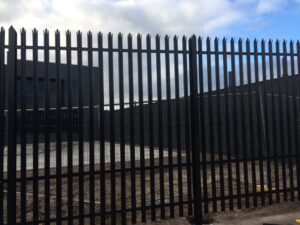
Choosing security steel fence panels involves more than selecting a design from a catalogue. A fence that looks substantial may still perform poorly if its posts, foundations, panel connections or gates are not designed for the conditions of the site.
For commercial and industrial properties, the fencing specification should consider the assets being protected, likely access risks, daily operations, ground conditions, environmental exposure and the way people and vehicles enter the property.
The objective is not simply to purchase the strongest-looking panel. It is to create a complete perimeter system in which the panels, posts, foundations, gates and finishes work together.
Boswen designs and fabricates steel fencing in tubular, picket-top, pressed-spear and other customised profiles for commercial, industrial and residential properties. Its steel fencing systems can be manufactured with galvanised or powder-coated finishes and coordinated with gates and other perimeter-security components.
What Are Security Steel Fence Panels?
Security steel fence panels are prefabricated sections installed between structural posts to create a permanent property boundary or security barrier.
A panel will generally include:
- Vertical steel pickets, pales or bars
- Horizontal rails
- Welded or mechanically connected joints
- Brackets or connections to the posts
- A protective galvanised or powder-coated finish
- A top profile suited to the intended security level
Unlike a lightweight decorative boundary fence, a security steel fence is usually selected to provide visible deterrence, restrict unauthorised access and withstand more demanding commercial or industrial use.
However, “security steel fencing” describes a broad family of systems. A tubular flat-top fence, a pressed-spear fence and a heavy-duty palisade system may all be made from steel, but they do not provide the same level of rigidity, climb deterrence or visual presentation.
The correct profile depends on the risks and operating requirements of the site.
Begin With the Site and Security Brief
Before selecting a panel, document what the perimeter needs to achieve.
Important questions include:
- Is the purpose boundary definition, controlled access or intrusion deterrence?
- What assets, people or operational areas are being protected?
- Is clear visibility through the fence required for CCTV or supervision?
- Will the fence face a public footpath, road, car park or internal restricted area?
- Are there nearby objects that could provide a climbing aid?
- Will vehicles or machinery operate close to the fence?
- Are there changes in ground level along the boundary?
- How many vehicle and pedestrian access points are needed?
- Does the site operate occasionally, daily or continuously?
- Will the gates need automation or access-control integration?
A warehouse boundary facing an isolated service road will have different requirements from a fence separating a school from a public footpath. Similarly, a visually prominent commercial entrance may require a more refined finish than a rear industrial perimeter.
The specification should start with these operational needs rather than a predetermined panel style.
Common Steel Fence Panel Profiles
Tubular flat-top fencing
Tubular steel panels generally use vertical hollow sections fixed between horizontal rails. A flat-top profile provides a clean and orderly appearance, making it suitable for commercial frontages, schools, landscaped areas and properties where visibility is important.
Its open construction allows light and sightlines through the boundary. The height, picket spacing, rail arrangement and steel-section dimensions can be adjusted according to the project.
Flat-top fencing can provide a clear physical boundary, but a site requiring stronger climb deterrence may need a different top profile.
Picket-top fencing
Picket-top panels extend the vertical members above the upper rail. This creates a more pronounced deterrent than a completely flat top while retaining the structured appearance of tubular fencing.
The picket shape and spacing need to be selected carefully where the fence adjoins public or pedestrian areas. Sharp or aggressive profiles may not be appropriate in every location.
Pressed-spear fencing

Pressed-spear fencing uses steel pickets formed into a pointed top. It offers a stronger visual deterrent and is commonly considered for commercial boundaries, industrial properties, schools and higher-security residential applications.
The performance of a pressed-spear panel depends on more than the pointed profile. Picket dimensions, spacing, rail strength, panel height, welding quality and post design all contribute to the completed system.
Boswen’s current steel-fencing range includes flat-top, loop-top and pressed-spear tubular designs, as well as more security-focused picket and spear-top configurations.
Palisade fencing

Palisade fencing uses heavier vertical steel pales attached to horizontal rails and structural posts. D-section and W-section profiles provide different levels of rigidity, with W-section pales generally intended for more demanding industrial and infrastructure applications.
Because palisade fencing is a distinct, higher-security product, buyers considering this profile should review Boswen’s dedicated palisade-fencing service rather than treating it as a minor variation of standard tubular panels. Boswen manufactures matching palisade swing, sliding and pedestrian gates to maintain a consistent perimeter.
High-security mesh systems
Sites exposed to more serious intrusion risks may require small-aperture welded mesh or another purpose-designed high-security system instead of conventional picket panels.
These systems are designed to minimise climbing footholds and provide greater resistance to cutting or tampering. Heavy-duty posts, secure fittings and appropriate foundations remain essential to their performance. Boswen treats these as a separate high-security fencing category for facilities requiring stricter perimeter control.
Specify the Steel Construction, Not Just the Style
Two panels with a similar appearance may perform differently because of their underlying construction.
The specification should identify or require the contractor to confirm:
- Steel type or grade
- Picket or pale section dimensions
- Wall or material thickness
- Number and dimensions of horizontal rails
- Maximum panel width
- Welding and fabrication method
- Post section and wall thickness
- Bracket and fixing arrangement
- Protective finish
- Gate-frame construction
Larger sections are not automatically the answer to every project. The components need to be proportioned as one system, taking into account panel height, span, wind exposure, ground conditions and likely loads.
Custom fabrication can be particularly useful where the site has non-standard openings, changes in level, unusual corners or architectural requirements. It allows panels and gates to be made around actual site dimensions rather than forcing standard panels into unsuitable spaces.
Select the Height and Spacing Carefully
Fence height affects deterrence, appearance, structural loads and cost. The correct height should be based on the site’s risk assessment and applicable project requirements rather than a universal rule.
A taller fence may improve access control, but it may also require:
- Heavier posts
- Deeper or larger foundations
- Additional rails
- Stronger panel connections
- Greater consideration of wind loading
- More careful coordination with gates
Picket or pale spacing is equally important.
Wider spacing provides greater openness and visibility but may reduce the sense of enclosure. Narrower spacing can strengthen the visual barrier but increases material use, weight and cost.
The designer should also consider:
- Potential footholds
- Spaces below the panel
- Changes in ground level
- Drainage paths
- Public accessibility
- Visibility for cameras or staff
- The risk of objects passing through the fence
- Local safety and access requirements
The aim is to achieve an appropriate balance between security, surveillance, safety and presentation.
Posts and Foundations Determine Long-Term Stability
Fence panels receive much of the visual attention, but the posts and foundations transfer loads into the ground and keep the entire system aligned.
An appropriate post and footing design depends on:
- Fence height and panel weight
- Panel width
- Soil and ground conditions
- Wind exposure
- Terrain and changes in level
- Proximity to retaining walls
- Underground services
- Potential vehicle impact
- Gate loads
- Site drainage
A standard footing detail should not be assumed to suit every boundary.
Soft or disturbed ground may need a different approach from stable natural soil. Sloping sites may require stepped or raked panels. Areas near retaining walls, pavements or services may also require a project-specific design and installation sequence.
Poor foundation design can lead to leaning posts, misaligned panels and gates that no longer operate correctly. These problems are difficult to solve through panel replacement alone because the underlying issue is below ground.
A professional site assessment should therefore occur before the final panel quantities and footing requirements are confirmed.
Choose a Finish for the Site Environment
Bare steel needs suitable protection against environmental exposure. Boswen’s steel fencing range uses galvanised steel and durable powder-coated finishes, while some palisade systems can use galvanising, powder coating or a combined finish.
Galvanised finish
Galvanising protects steel by applying a zinc coating. It is commonly selected for industrial environments, exposed boundaries and projects where long-term corrosion resistance is a major consideration.
The visual finish is metallic rather than colour-matched, although its appearance changes naturally as it weathers.
Powder-coated finish
Powder coating provides a coloured finish and can help the fence coordinate with the building, gates, landscaping or brand requirements.
The underlying steel preparation is important. Damage during transport, installation or later site operations should be identified and addressed according to the specified repair process.
Combined protective system
For more corrosive or visually demanding environments, a project may use galvanised steel with a compatible powder-coated finish.
The final selection should consider:
- Distance from coastal exposure
- Industrial pollutants
- Moisture and drainage
- Contact with soil or vegetation
- Required colour
- Desired service life
- Maintenance access
- Client or project specifications
The lowest initial-cost finish may not provide the best whole-of-life value if the fence is installed in an aggressive environment.
Integrate Vehicle and Pedestrian Gates From the Start
A fence specification is incomplete until every opening has been resolved.
Gates are moving components and experience loads that fixed panels do not. They should therefore be designed around:
- Clear opening width
- Vehicle dimensions and turning paths
- Pedestrian circulation
- Frequency of operation
- Gate weight and frame rigidity
- Swing area or sliding run-back
- Ground slope
- Tracks, hinges or cantilever supports
- Wind exposure
- Manual or automatic operation
- Safety devices
- Access-control requirements
- Emergency and maintenance access
A matching security steel fence gate should use an infill, height and finish that remain consistent with the surrounding fence. However, matching appearance is only one requirement. The gate frame must also resist movement and maintain alignment through repeated operation.
Where automation is planned, the motor and safety system should be selected around the completed gate’s size, weight and duty cycle—not added as an afterthought.
Pedestrian gates also require careful consideration. The opening, latch, closer, access device and surrounding fence should work together without creating a weak or impractical access point.
What Affects the Cost of Security Steel Fence Panels?
Pricing is influenced by more than the total number of lineal metres.
Major cost factors include:
- Panel profile
- Steel section sizes and thicknesses
- Fence height
- Panel width
- Number of rails
- Picket or pale spacing
- Galvanised, powder-coated or combined finish
- Number and type of gates
- Automation and access control
- Ground and excavation conditions
- Sloping or stepped boundaries
- Demolition of existing fencing
- Site access
- Traffic or pedestrian management
- Engineering and documentation
- Installation programme
A low panel price may exclude posts, foundations, gates, coatings or installation requirements that substantially affect the completed project.
Quotes should therefore be compared by scope, specification and inclusions—not only by the price per panel or metre.
Security Steel Fence Panel Specification Checklist
Before approving a proposal, confirm the following:
Site and purpose
- What is the required security outcome?
- Which areas and assets are being protected?
- Are surveillance sightlines required?
- Is the fence exposed to public access or potential vehicle impact?
Panel design
- What panel profile is proposed?
- What are the picket, pale and rail dimensions?
- What is the panel width?
- What is the fence height?
- What is the spacing between vertical members?
- How are panels attached to the posts?
Posts and foundations
- What post sections are specified?
- How were footing dimensions determined?
- Have soil, slope, drainage and underground services been considered?
- Are retaining walls or existing pavements involved?
Protective finish
- Is the steel galvanised, powder coated or both?
- Is the finish suitable for the local environment?
- What colour and surface appearance are required?
- How will coating damage be repaired?
Gates and access
- How many vehicle and pedestrian gates are needed?
- What clear opening is required?
- Will gates swing, slide or use a cantilever configuration?
- Is automation required?
- What safety and access-control equipment is needed?
- Does the gate infill match the fence?
Project delivery
- Are fabrication drawings required?
- Who will measure and verify the site?
- What preparation or demolition is included?
- How will installation affect ongoing operations?
- What inspections and handover information will be provided?
Frequently Asked Questions
What is the best profile for a security steel fence?
There is no single best profile. Tubular flat-top fencing may suit a visible commercial frontage, pressed-spear fencing may provide stronger climb deterrence, and palisade or small-aperture mesh may be more appropriate for higher-risk industrial sites. Selection should follow the site and security assessment.
Are taller steel fence panels always more secure?
Not necessarily. Height is only one factor. Picket spacing, climb aids, post strength, foundations, gates and surrounding site conditions also affect the perimeter’s performance.
Should the gate use the same steel panel design as the fence?
Using matching infill can create a consistent appearance and security profile. The gate still requires a separate structural design because it moves and must support its own weight during regular operation.
Is galvanised or powder-coated steel better?
The answer depends on the environment and visual requirements. Galvanising is commonly selected for corrosion resistance, while powder coating adds colour and architectural coordination. Some projects use both.
Can security steel fence panels be installed on sloping ground?
Yes, but the panel arrangement, post positions, gaps below the fence and foundations need to be planned around the slope. Panels may be stepped, raked or custom fabricated depending on the design.
Plan the Complete Perimeter, Not Only the Panels
The most suitable security steel fence panels are those that form part of a properly coordinated system.
Panel profile, steel construction, height, spacing, posts, foundations, protective finish and gates all affect the finished result. Selecting these components together helps create a perimeter that is practical to install, appropriate for the site and reliable during long-term use.
Boswen provides site assessment, custom design, fabrication and installation for steel fencing and gate projects across commercial, industrial and other demanding environments.
Request a site assessment and tailored steel fencing quote for your property.