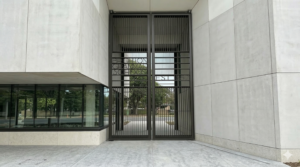
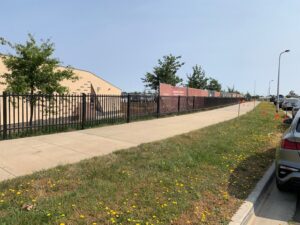
Pressed spear fencing and palisade fencing are both rigid steel perimeter systems, but they are not interchangeable. A pressed spear top fence is typically chosen when a project needs a strong, open steel boundary with a refined architectural appearance. Palisade fencing is generally specified when the perimeter itself needs to communicate a higher level of deterrence and physical resistance.
For schools, public facilities, commercial properties and industrial sites, the better choice depends on risk, visibility, public interface, gate design and the way the boundary should look from the street.
This guide compares the two systems so project owners and designers can choose a security metal fence that fits the actual site.
How Pressed Spear and Palisade Fencing Differ
The clearest difference is the way the vertical steel members are formed and supported. Pressed spear fencing is commonly built as a tubular steel panel with square or rectangular pickets fixed between horizontal rails. The upper end of each picket is pressed into a spear-shaped point, creating a deterrent while keeping the fence visually similar to architectural steel picket fencing.
Boswen’s steel fencing range includes tubular designs such as flat top, loop top and pressed spear. A current pressed spear product example uses 25 mm square hollow-section pickets with 40 mm square hollow-section rails; final dimensions and spacing should still be specified for the project.
Palisade fencing uses heavier individual steel pales fixed to horizontal rails and structural posts. Boswen’s palisade range includes D-section and W-section pale profiles. W-section pales use a corrugated form that increases rigidity and resistance to bending, while D-section profiles can provide a cleaner visual treatment for commercial and institutional applications.
At-a-Glance Selection Table
| Selection factor | Pressed spear fencing | Palisade fencing |
| Overall character | Architectural, orderly and security-focused | More overtly defensive and industrial |
| Vertical members | Tubular steel pickets with pressed spear tops | D-section or W-section steel pales |
| Typical visual use | Schools, public-facing commercial sites, residential developments, civic facilities | Industrial plants, logistics yards, utilities, infrastructure and higher-risk boundaries |
| Deterrence | Clear pointed-top deterrent with open visibility | Stronger visual deterrent and more robust pale profiles |
| Visibility through fence | High, depending on picket spacing | High, depending on pale spacing and profile |
| Gate matching | Can be continued through pedestrian, swing or sliding gates | Can be continued through pedestrian, swing or sliding palisade gates |
| Finish options | Commonly galvanised and/or powder coated to project requirements | Commonly galvanised and/or powder coated to project requirements |
| Best decision basis | Appearance, public interface, risk level and gate coordination | Risk level, rigidity, deterrence and industrial/security context |
Security and Rigidity: Start with the Threat, Not the Fence Style
Both systems can provide a strong perimeter, but “security” should be defined in relation to the site. A school boundary, an office development and a utility substation do not face the same risks, even if all three require steel fencing.
Pressed spear fencing provides a rigid steel barrier with pointed picket tops that discourage casual climbing and make the boundary visually clear. Its strength comes from the combination of pickets, rails, posts, connections and foundations. For many public-facing and commercial projects, that balance is sufficient without making the site look excessively fortified.
A steel palisade fence is normally selected where the required deterrence is more explicit. The pale profiles, especially corrugated W-section pales, are designed to resist deformation more effectively than lighter tubular pickets. The fence also presents a more formidable visual barrier, which can be useful for industrial, logistics and infrastructure environments where perimeter security is a primary design objective.
Neither system should be labelled universally “high security” based on appearance alone. Performance depends on the full specification, including steel section, height, spacing, posts, foundations and gates. Higher-risk sites may require a dedicated high-security fencing system.
Appearance and Public-Facing Use
Appearance often becomes decisive beside streets, school entrances, community buildings and commercial frontages. Pressed spear fencing uses slender tubular pickets and can be powder coated to coordinate with buildings and gates, adding a security cue without an overly industrial look.
That can suit schools, council facilities, apartment developments, offices and other public-facing projects, subject to the site’s safety and design requirements.
Visibility, Surveillance and Picket Spacing
Both systems are open fences, which helps preserve sightlines for staff, security personnel and CCTV compared with solid fencing.
Where CCTV is used, fence spacing should be coordinated with cameras, lighting and landscaping so surveillance coverage remains useful.
Fence Height and the Level of Deterrence
Height influences deterrence, but it should be specified as part of the whole system. Taller fencing cannot compensate for weak gates, poor foundations or nearby climbing aids.
Boswen’s palisade range is available in multiple heights and profiles, including higher W-section systems for more demanding industrial and security applications. Where a site requires a substantial deterrent, palisade generally offers more scope for a visibly robust perimeter without changing to mesh-based high-security fencing.
Maintenance and Finish Considerations
Steel fencing performs best when the finish suits the environment and coating damage is repaired early. Boswen offers galvanised and powder-coated systems, including dual-finish palisade options where required.
Maintenance should include checks of coatings, posts, rails, fixings and gates. Industrial and coastal environments can require different coating strategies, so finish selection should be treated as a performance decision, not only a colour choice.
Matching Pedestrian and Vehicle Gates
The gate should be planned with the fence. A strong fixed boundary loses practical value if the access point is undersized, difficult to operate or visibly weaker.
Palisade gates can also use matching pales and finishes. Boswen manufactures pedestrian, swing and sliding palisade gates, with automation and access control where required. Busy entrances should be designed around traffic frequency, clear opening and available operating space.
Typical Applications for Pressed Spear Fencing
Pressed spear fencing is often well suited to sites where security needs to coexist with a more formal or architectural presentation. Typical applications can include:
- School and education perimeters where an open, orderly steel boundary is preferred
- Council and community facilities with public-facing frontages
- Commercial offices, car parks and mixed-use developments
- Residential developments and shared property boundaries requiring a premium steel appearance
- Pedestrian entrances and vehicle gates that need to visually match the surrounding fence
Typical Applications for Palisade Fencing
Palisade fencing is generally a stronger fit where the boundary must visibly communicate restricted access and resist more demanding conditions. Typical applications can include:
- Manufacturing plants and industrial facilities
- Warehouses, distribution centres and logistics yards
- Utilities and infrastructure compounds
- Transport and rail environments
- Commercial sites with higher perimeter-security requirements
- Sites where a heavier, more defensive steel profile is appropriate to the risk
Which Steel Fence Should You Choose?
The simplest way to choose between pressed spear and palisade is to ask what the perimeter needs to achieve before comparing profiles.
- Choose pressed spear when the site needs a strong steel boundary, clear visibility and a more architectural or public-facing appearance.
- Choose palisade when the site needs a more overt deterrent, heavier pale profiles and an industrial or security-led character.
- Consider a dedicated high-security fence when the risk assessment calls for anti-climb, anti-cut or other specialised performance beyond a conventional rigid steel fence.
- In all cases, coordinate fence height, spacing, posts, foundations, finish, gates and access control as one design rather than selecting each component independently.
Cost is project-specific. Steel section, height, coating, foundations, site access, gate size and automation all affect price, so the lowest initial fence cost is not necessarily the best value if it misses the security or architectural brief.
Plan the Perimeter Around the Site
Pressed spear and palisade fencing are both useful steel perimeter solutions, but they solve different design problems. Pressed spear fencing tends to offer a more refined balance of security and appearance, while palisade fencing provides a stronger security identity and greater rigidity for demanding commercial and industrial environments.
Boswen designs, fabricates and installs steel fencing, palisade fencing, matching gates and higher-security perimeter systems. The right recommendation depends on the site layout, risk, appearance and access requirements.
Need help choosing the steel fence profile that fits your site? Request a custom fencing recommendation from Boswen.
Frequently Asked Questions
Is pressed spear fencing the same as palisade fencing?
No. Pressed spear fencing generally uses tubular steel pickets with the upper ends pressed into spear-shaped points. Palisade fencing uses individual profiled steel pales, commonly D-section or W-section, fixed to horizontal rails and structural posts.
Which is more secure: pressed spear or palisade fencing?
Palisade fencing generally provides the more overt deterrent and can offer greater pale rigidity, particularly with heavier W-section profiles. However, security depends on the complete fence specification, including height, spacing, rails, posts, foundations, gates and access control. Higher-risk sites may require a dedicated high-security fencing system.
Is pressed spear fencing suitable for schools and public facilities?
It can be suitable where the project requires a strong, open steel boundary with a more architectural appearance. The exact height, picket spacing, spear profile and location should be assessed against the site’s safety, design and compliance requirements.
Can pressed spear and palisade fences have matching gates?
Yes. Both systems can be coordinated with pedestrian, swing or sliding gates using matching steel infill and finishes. Vehicle gates may also be automated and integrated with access-control systems where required.
Which fence offers better visibility?
Both are open steel fencing systems and can maintain clear sightlines. Actual visibility depends on the width, spacing and profile of the pickets or pales, as well as the fence height and viewing angle.
Does palisade fencing need more maintenance than pressed spear fencing?
Maintenance requirements depend more on the finish, environment, impact exposure and installation than on the name of the fence. Both systems should be inspected periodically for coating damage, corrosion, loose or damaged components and gate issues.