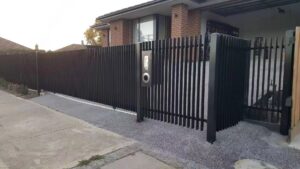
Replacing or installing a boundary fence is one of the most common property improvement projects in Melbourne — and one of the most frequently misunderstood. Between the questions about shared costs, council rules, material choices, and neighbour agreements, many homeowners and business owners put it off far longer than they should.
Good neighbour fencing cuts through a lot of that complexity. It is a specific type of boundary fence designed to look equally presentable on both sides of the property line — which changes everything about how the conversation with your neighbour begins, and how smoothly the installation proceeds.
This guide explains what good neighbour fencing is, how it is built, why the design matters, what Victorian law says about boundary fences, and how to decide whether it is the right choice for your property.
What is good neighbour fencing?
Good neighbour fencing — sometimes written as “good neighbor fencing” — is a style of boundary fence in which the rails, posts, and structural framework are concealed between two facing panels, presenting a clean, flat, finished surface to both properties at once.
In a conventional paling or panel fence, one side sees the smooth face of the fence boards while the other sees the exposed rails and back of the structure. The property that funded the fence typically takes the “good” side. The neighbour gets the back.
Good neighbour fencing eliminates this asymmetry entirely. Both sides see the same face. Neither property is disadvantaged, neither neighbour feels like they received the lesser half of a shared investment, and the boundary between two properties becomes a genuinely shared feature rather than a contested one.
This is not just an aesthetic consideration. It has practical implications for property value, neighbourhood relations, and the ease of getting neighbour agreement before installation begins.
How is a good neighbour fence constructed?
The defining structural characteristic is the alternating pale arrangement. Rather than all pales facing the same direction, pales alternate throughout the panel — one faces your property, the next faces the neighbour’s — along the entire fence run. The rails sit centrally in this alternating structure, hidden from both sides.
At Boswen, our good neighbour fencing systems are manufactured from steel — not timber. This is an important distinction from what many people picture when they hear “good neighbour fence,” which is often associated with the traditional timber paling style common across older Melbourne suburbs. Steel good neighbour fencing delivers the same symmetrical aesthetic with significantly better durability, corrosion resistance, and a longer service life without the ongoing maintenance that timber demands.
Key components of a steel good neighbour fence installation:
Steel posts set into concrete footings at regular intervals — typically 2.4 to 2.7 metres apart — depending on fence height and local soil conditions.
Horizontal rails fixed between posts at top, middle, and bottom positions, forming the concealed structural spine of the fence.
Steel pales fixed alternately to the front and back of the rails, creating the symmetrical double-sided appearance from both properties.
Capping rail along the top edge, providing a finished profile and preventing water accumulation in the rail cavity.
The system is powder-coated in a range of colours. In Melbourne, Colorbond-style palette options are popular — Ironstone, Woodland Grey, Surfmist, and Monument among the most frequently specified for residential boundaries. The colour applies equally to both faces, which maintains the symmetry that defines the fence type.
Why does good neighbour fencing matter?
It protects the relationship with your neighbour from the start
Boundary fencing disputes are among the most common sources of neighbour conflict in Victoria. They typically begin with one party feeling they have been handed the unfair side of a decision — the unattractive face of a new fence, a cost they were not consulted on, or a style they did not agree to.
Good neighbour fencing removes the most common flashpoint before it ignites. When you can show your neighbour that the fence will look identical from their side as from yours, you have already addressed the most frequent objection.
It adds value to both properties
A well-presented boundary fence contributes to street appeal and perceived property quality on both sides. A fence that looks clean and modern from the street front or rear boundary improves the visual presentation of both properties — which matters at sale time for both neighbours, not just the one who initiated the installation.
It meets council and planning expectations
Many Melbourne councils and body corporate arrangements specify that new boundary fencing must present a finished appearance to both sides. A standard paling fence with exposed rails on one side can fail this requirement. Good neighbour fencing satisfies the “acceptable from both sides” standard built into most planning requirements without needing to add a second cladding layer to the exposed face.
It reflects the legal reality of a shared boundary
Under the Fences Act 1968 (Victoria), a dividing fence is a shared asset. A fence that demonstrably advantages one property over another in appearance or maintenance burden can complicate any cost-sharing discussion that follows. Good neighbour fencing, being symmetrical by design, sidesteps this issue entirely.
What does Victorian law say about boundary fences?
This is where many Melbourne property owners are uncertain — and where getting the basics right before you start saves significant friction later.
The Fences Act 1968 (Victoria) governs the rights and responsibilities of neighbouring property owners in relation to dividing fences. The key principles are:
Shared cost is the starting point. The cost of a sufficient dividing fence is generally shared equally between adjoining owners, unless the fence is required to be of a higher standard for one party’s benefit, in which case that party contributes the additional cost above the sufficient-fence standard.
Notice is required before installation. Before proceeding with a new or replacement dividing fence, you must give your neighbour a Fencing Notice setting out the proposed type, materials, location, and estimated cost. Your neighbour then has 30 days to agree, propose alterations, or dispute the notice.
A “sufficient fence” is the baseline. The Act uses the standard of a “sufficient dividing fence” — one that is structurally sound and appropriate to the area. Steel good neighbour fencing typically meets and exceeds this standard, which supports its use in cost-sharing discussions.
Agreement on style matters. If both neighbours agree on a specific fence type and that is documented in writing, both parties are protected. If a neighbour requests a cheaper alternative, they may only be obliged to contribute their share of that cheaper option’s cost.
For complex boundary situations — corner lots, sloped sites, or properties with existing disputes — speaking with your local council or a fencing contractor experienced with Melbourne’s residential codes before issuing a Fencing Notice is a sensible first step.
Where is good neighbour fencing used?
Good neighbour fencing suits a wider range of applications than many people initially assume.
Residential side and rear boundaries. The most common application — the boundary between two suburban Melbourne homes where both owners have an interest in the fence appearance and neighbourhood relations make symmetry the practical approach.
Front boundary fencing. Where a property has a front boundary facing a neighbour’s side or rear garden, a good neighbour fence presents cleanly to both the street and the adjacent property.
Commercial and light industrial boundaries. Shared boundaries between commercial properties — a warehouse adjacent to a retail premises, or an office development next to a residential zone — often benefit from good neighbour fencing. It handles the mixed-use interface cleanly and avoids one business imposing an industrial-looking fence face onto a neighbouring residential property.
Body corporate and strata developments. In townhouse developments and strata complexes, the body corporate frequently specifies good neighbour fencing for internal lot boundaries to maintain visual consistency throughout the development.
Schools, childcare centres, and community facilities. Properties with sensitive neighbours often choose good neighbour fencing because it signals genuine respect for the adjoining property as much as it performs a boundary function.
Good neighbour fencing vs other boundary options
Understanding where good neighbour fencing sits relative to other options helps you make a confident choice.
vs standard timber paling fence. Timber paling is cheaper upfront but requires regular painting or oiling, is vulnerable to warping and moisture damage, and presents one finished face and one structural back. Steel good neighbour fencing costs more to install but requires no repainting, resists warping, and lasts significantly longer.
vs slat fencing and privacy screens. Slat fencing and privacy screens deliver a more contemporary design aesthetic and are excellent for residential settings where visual style is the priority. Slat fencing typically presents differently on each side. Good neighbour fencing is the choice when symmetry and equal presentation are the primary requirement.
vs steel security and palisade fencing. If boundary security — rather than appearance — is the primary need, a steel security fence or palisade fence may be more appropriate. These systems prioritise intrusion resistance. For most residential and light commercial boundaries, good neighbour fencing provides adequate security alongside its appearance advantages.
vs standard colorbond panel fencing. Pre-formed steel panel fencing presents one flush face and one ribbed structural back. Good neighbour fencing achieves the same steel durability and colour options while solving the two-sided appearance problem that standard panel fencing does not address.
What to look for in a good neighbour fence installation
Installation quality matters as much as material quality. A few things to verify when engaging a contractor:
Correct post depth for Melbourne’s soil. Posts in reactive clay — common across Melbourne’s northern, western, and south-eastern suburbs — must be set deeper than in stable soil to maintain fence alignment over time. An experienced contractor assesses this at the site visit stage, not after the posts are already in the ground.
Consistent pale spacing throughout the run. The alternating pale arrangement should be even from one end to the other. Uneven spacing compromises the symmetrical appearance and can indicate rushed work.
Properly finished capping. Top capping should be level, fully sealed at joins, and powder-coated to match the fence colour. An unfinished or poorly sealed top edge allows water into the rail cavity, which accelerates internal corrosion.
Gate integration. If your boundary fence includes a gate — a swing gate for pedestrian access or a sliding gate for vehicle entry — the gate frame and finish should match the fence profile and colour. A gate that does not coordinate with the good neighbour fence undermines the symmetrical presentation at the most visible point on the boundary.
Working with a contractor who manages both the fence and the gate as a single scope avoids the mismatches that occur when two different trades work on connected elements.
Is good neighbour fencing right for your property?
Good neighbour fencing is a strong fit when:
- You share a boundary with a residential neighbour and appearance matters to both parties
- Your council or body corporate requires a finished presentation on both sides
- You want a low-maintenance boundary solution with a long service life
- You are replacing a deteriorating timber fence and want to upgrade to steel without compromising on neighbour relations
- Keeping the relationship with your neighbour intact is as important as the fence itself
It may not be the best choice when:
- The primary requirement is perimeter security — palisade fencing or high security fencing is more appropriate in that case
- The boundary is a rear fence with no visibility and the only driver is cost
- A highly contemporary design aesthetic is the goal — slat fencing or privacy screens may be a better fit
Talk to Boswen about good neighbour fencing in Melbourne
Boswen manufactures and installs steel good neighbour fencing across metropolitan Melbourne for residential, commercial, and light industrial properties. Our team assesses your boundary, advises on material and colour options, and manages the full installation — including matching gate systems where required.
If you are comparing options, preparing a Fencing Notice, or working out what a good neighbour fence would cost for your specific boundary, our team can provide an honest assessment.
View Boswen’s good neighbour fencing →
Frequently asked questions
Is good neighbour fencing more expensive than a standard fence? The upfront cost is generally higher than a timber paling fence. However, steel good neighbour fencing requires no repainting, resists rot and warping, and has a longer service life — making the 10-to-15-year total cost of ownership often lower than maintaining and eventually replacing a timber alternative.
Can my neighbour be required to share the cost? Under the Victorian Fences Act 1968, the cost of a sufficient dividing fence is generally shared equally between adjoining owners. If both neighbours agree on good neighbour fencing, the cost is typically split evenly. If one neighbour prefers a cheaper option, they may only be required to contribute their share of that cheaper cost.
How long does a steel good neighbour fence last in Melbourne? A hot-dip galvanised steel good neighbour fence, properly installed, typically achieves a service life of 25 to 40 years in Melbourne’s climate. Powder-coat surfaces benefit from an inspection every 10 to 15 years.
Do I need council approval? In most Melbourne residential zones, boundary fences up to 2.0 metres do not require a planning permit, but a building permit may apply depending on height and material. Rules vary by council area. Boswen manages permit assessment as part of every project scope.
What colours can I choose? Good neighbour fencing is powder-coated in a full range of colours. Popular choices across Melbourne include Ironstone, Woodland Grey, Surfmist, Monument, and Basalt — all of which coordinate well with common brick tones and cladding materials used in Melbourne’s residential housing stock.
Related reading
- Slat fencing and privacy screens — An alternative for boundaries where contemporary design and maximum privacy are the priority.
- Choosing the right fencing contractors for your property in Melbourne — What to look for when selecting a fencing contractor, from licensing to project management.
- The real cost of poor fencing installation and how to avoid it — Why installation quality matters as much as material selection.
- Quality fences and gates for every property — An overview of Boswen’s full range of fencing and gate solutions for residential and commercial properties.
Boswen Aust Pty Ltd is a Melbourne-based fencing and metalworks contractor. We design, manufacture, and install good neighbour fencing, steel security fencing, palisade fencing, gates, and metalwork across metropolitan Melbourne and regional Victoria.