If you manage a commercial or industrial site in Melbourne, perimeter security is rarely an afterthought. A breach in your boundary — whether from an intruder, a vehicle, or opportunistic theft — can result in costly damage, liability exposure, and serious risk to people on site. Choosing the right fencing system from the start is one of the most effective decisions you can make.
Palisade fencing is consistently one of the most specified security barriers across Melbourne’s industrial, infrastructure, and commercial sectors. Yet many property managers and site owners are unfamiliar with how it works, what sets it apart, and whether it is the right fit for their site.
This article explains exactly what palisade fencing is, how it is constructed, what makes it effective, and where it is commonly deployed across Melbourne. If you are evaluating your perimeter security options, this is your starting point.
What is palisade fencing?
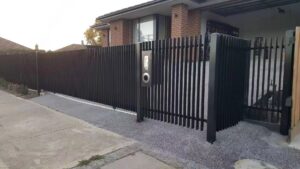
Palisade fencing is a rigid, steel-based barrier system made up of vertical steel pales — typically D-section, W-section, or triple-pointed — fixed horizontally to steel rails and structural posts. The pales project above the top rail, forming an imposing pointed or serrated profile that is extremely difficult to climb or grip.
Unlike mesh-based systems, palisade fencing is a solid, engineered structure. Each component is purpose-built to resist physical attack, forced entry, and climbing attempts. The design relies on both physical strength and visual deterrence: the appearance alone communicates that a site is protected.
Palisade fences are typically hot-dip galvanised to Australian and British standards (including BS1722-12 where specified), providing long-term corrosion resistance in Melbourne’s variable climate — from the coastal salt air in bayside suburbs to the harsher industrial environments of the outer western corridor.
How is a palisade fence constructed?
Understanding the construction helps you evaluate whether a palisade system meets your site’s requirements.
Steel pales form the vertical members. The most common profiles are:
- D-section pales — a curved profile offering a clean, semi-decorative appearance alongside strong resistance to bending
- W-section pales — a wider, ribbed profile that maximises rigidity and is preferred for maximum-security applications
- Triple-pointed tops — a finishing detail that increases anti-climb performance and acts as a strong visual deterrent
Horizontal rails connect the pales at two or three heights, depending on fence height and security grade. Rails are typically RHS (rectangular hollow section) steel, welded or bolted to the pale assembly.
Structural posts are set into concrete footings at measured intervals — typically 2.5 to 3 metres — providing the framework that holds the entire system rigid under lateral load.
The system is available in a range of heights. Standard commercial installations in Melbourne typically run from 1.8 metres to 2.4 metres. High-security sites — substations, correctional facilities, data centres — often specify 2.4 metres to 3.0 metres, sometimes with additional topping such as anti-climb spikes or barbed wire extensions where permitted.
For a closer look at Boswen’s palisade fence specifications and available configurations, visit the Boswen palisade fencing product page.
What makes palisade fencing effective for security?
Palisade fencing earns its reputation through a combination of properties that most other fencing types cannot match simultaneously.
Physical resistance. Steel pales are extremely difficult to cut, bend, or dislodge without specialist tools and significant time. The structural integrity of a well-installed palisade fence means an intruder cannot simply force a panel out of position.
Anti-climb design. The projecting pointed tops, combined with the narrow gaps between pales, make climbing the fence extremely difficult. There is no foothold, no flat surface to grip, and no gap wide enough to use as a step. This is a significant advantage over systems like chainwire fencing, which — while cost-effective and widely used — offers footholds throughout its mesh structure.
Visual deterrence. Research consistently shows that perimeter barriers influence criminal decision-making before any physical contact occurs. Palisade fencing’s imposing appearance — the pointed tops, rigid uprights, and evident structural weight — discourages opportunistic intrusion at the outset.
Low maintenance over the long term. Hot-dip galvanising provides corrosion protection that typically outlasts powder-coat finishes and requires no repainting cycle. For Melbourne industrial sites where maintenance budgets and access windows are constrained, this is a practical advantage.
Visibility through the fence. Unlike solid panel fencing, palisade systems allow sightlines through the perimeter. This means security cameras positioned inside the boundary can monitor approaches without obstruction, and on-site security personnel can observe movement outside the fence line.
Where is palisade fencing used in Melbourne?
Melbourne’s industrial growth — particularly across the western suburbs, the south-eastern manufacturing corridor, and major infrastructure projects — has driven sustained demand for robust perimeter security. Palisade fencing appears across a broad range of site types.
Industrial and manufacturing facilities
Warehouses, logistics hubs, and manufacturing plants in suburbs like Dandenong, Sunshine, Laverton, and Campbellfield are among the most common settings for palisade fencing in Melbourne. These sites face consistent risks: opportunistic theft of stored goods, after-hours vehicle intrusion, and liability concerns around unauthorised access to hazardous areas.
Palisade fencing defines the perimeter clearly, controls access to a managed entry point, and provides a barrier that remains effective without requiring continuous monitoring.
Utilities and critical infrastructure
Melbourne’s water treatment facilities, electrical substations, and telecommunications infrastructure sites routinely specify palisade fencing. These sites often have high-consequence access risks — a breach is not just a theft risk but a potential public safety or service continuity issue. The fence grade specified for these applications is typically higher, with W-section pales, taller heights, and anti-climb additions.
Transport and logistics
Rail yards, container depots, bus depots, and airport support precincts require perimeter security that can handle large boundary runs, integrate with vehicle entry gates, and withstand the traffic and vibration loads common on busy sites. Palisade fencing handles these conditions well, particularly when paired with a matching sliding gate or boom gate system at vehicle entry points.
Government and institutional facilities
Local councils, correctional facilities, court complexes, defence establishments, and hospitals across Greater Melbourne specify palisade fencing where both security and a degree of visual presence are required. The fence communicates authorised-access-only clearly and visibly, which is important for both security and public compliance.
Commercial and retail precincts
Large-format retail sites, shopping centre service yards, and commercial estates increasingly turn to palisade fencing to protect loading docks, plant rooms, and after-hours perimeters. Unlike chainwire fencing — which is better suited to high-run, lower-risk boundaries — palisade is chosen where the risk level, asset value, or site profile justifies a higher-grade solution.
For sites requiring an additional layer of access control at pedestrian entry points, a pedestrian access gate integrated into the palisade fence line is a practical and commonly specified combination.
Schools and educational institutions
A growing number of Melbourne schools and TAFEs install palisade fencing along boundary sections that face public thoroughfares or that adjoin higher-risk areas. The fence height and pointed top profile act as a clear boundary marker, reducing after-hours access to the grounds without creating the oppressive visual effect of a solid wall.
Palisade fencing versus other security fencing types
It is worth understanding where palisade fits within the broader range of security fencing options, because not every site needs the same level of protection.
Palisade vs chainwire fencing. Chainwire (cyclone wire) fencing remains the dominant choice for large-run, moderate-security applications — construction sites, sports facilities, boundary delineation. It is cost-effective and fast to install. Palisade is specified when the security threshold is higher, when the site profile requires a stronger deterrent, or when anti-climb performance is a priority.
Palisade vs weldmesh panels. Weldmesh offers a clean, flat appearance that suits some commercial settings. For sites where aesthetics matter alongside security — corporate campuses, for instance — weldmesh may be appropriate. Palisade outperforms weldmesh on anti-climb and physical resistance.
Palisade vs high security fencing. Boswen’s high security fencing systems are specified for maximum-threat environments — defence, corrections, critical infrastructure — and combine anti-cut mesh, anti-climb design, and detection integration. Palisade sits in the tier below: a robust, widely applicable solution for commercial and industrial sites rather than the absolute highest-security tier.
Palisade with security bollards. On sites where vehicle intrusion is a risk alongside pedestrian intrusion — fuel depots, critical infrastructure sites, government buildings — palisade fencing is often complemented by security bollards at vehicle approach points. The two systems together address both threat vectors.
For a more detailed side-by-side comparison, our article on the benefits of a steel security fence or chainwire mesh fence walks through the decision framework many Melbourne site managers use.
What to look for in a palisade fence installation in Melbourne
The quality of a palisade fence installation varies significantly between contractors. A poorly installed system — regardless of the material grade — introduces gaps in perimeter integrity that undermine the purpose of the investment. Here is what an experienced installation should include.
Site assessment and engineering. Posts must be set to the correct depth for Melbourne’s soil conditions, which range from reactive clay in the northern and western suburbs to rock-based profiles in the Dandenong Ranges foothills. Footings that are undersized or improperly spaced compromise the fence’s resistance to lateral force.
Compliance with Australian standards. Hot-dip galvanising to AS/NZS 4680, material specifications aligned with the site’s security grade, and proper post-to-rail connections are all part of a compliant installation.
Integration with gates and access control. A palisade fence is only as secure as its weakest access point. Gate systems — whether sliding, swing, or cantilever — should be designed to match the fence profile and grade, and installed by a contractor who manages both the fence and the gate as a unified system.
Experience with your site type. A contractor who has installed palisade fencing across industrial, infrastructure, and commercial sites in Melbourne brings relevant knowledge of local council permit requirements, utility clearance protocols, and site-specific challenges. Boswen’s team works across Melbourne’s metropolitan and outer suburban areas, and brings that hands-on experience to every project. Learn more about working with a professional fencing contractor in Melbourne.
Is palisade fencing right for your Melbourne site?
Palisade fencing is a strong fit when one or more of the following apply to your site:
- You need to control unauthorised after-hours access to a commercial or industrial property
- Your site contains high-value assets, hazardous equipment, or restricted areas
- You are managing a large perimeter where visual deterrence is as important as physical security
- You need a fence system that is low-maintenance over a 10-to-20-year lifespan
- Your site is subject to specific security standards or compliance requirements
It may not be the first choice if your primary need is internal boundary delineation, low-visibility fencing for a residential property, or a cost-minimised long-run boundary with low intrusion risk — situations where chainwire or good neighbour fencing are typically more appropriate.
Talk to Boswen about palisade fencing for your Melbourne site
Boswen is a Melbourne-based fencing contractor with direct experience installing palisade fence systems across a wide range of commercial and industrial sites. Our team manages projects from initial site assessment through to installation and handover, and we work with your schedule, site constraints, and compliance requirements.
If you are at the evaluation stage — comparing options, gathering specifications, or preparing a brief — our team can provide a no-obligation assessment and quote.
View our palisade fencing systems →
Frequently asked questions
How long does a palisade fence last in Melbourne’s climate? A hot-dip galvanised palisade fence installed to standard is designed for a service life of 25 to 40 years in typical Melbourne conditions. Coastal or highly industrial environments may require additional protective treatment. Regular inspections to check post footings and pale connections help maximise service life.
Do I need a permit to install a palisade fence in Melbourne? Permit requirements depend on the fence height, zoning, and your local council. Fences above 2.0 metres on commercial or industrial land generally require a building permit in most Melbourne councils. Boswen manages this process as part of every installation project.
Can palisade fencing be installed on uneven ground? Yes. Palisade fencing can be raked (following the ground slope) or stepped (installed in horizontal sections with stepped panels) to suit undulating terrain. Your contractor should assess the site and specify the appropriate approach before installation.
What gate types work with palisade fencing? Palisade fence systems integrate with sliding gates, cantilever gates, swing gates, and pedestrian access gates. The gate should be matched to the fence grade and profile for a unified, secure system.
Is palisade fencing suitable for a school or council facility? Yes — palisade is commonly specified for educational and government facilities in Melbourne, particularly on boundary sections facing public roads or adjacent to higher-risk areas. Gate integration and fence height are typically assessed case by case.