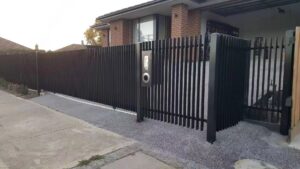
Replacing a boundary fence in Melbourne almost always leads to the same shortlist: Colorbond panel fencing or aluminium slat fencing. Both are steel-derived systems. Both are widely installed across Melbourne’s residential suburbs. Both are marketed as low-maintenance, durable privacy solutions.
But they are fundamentally different products — in how they look, how they perform, how they age, and what they cost to own over a decade or more. The choice between them is not a minor detail; it shapes the appearance of your property for the next 20 to 30 years.
This article compares both systems honestly across every factor that matters to a Melbourne homeowner: privacy, aesthetics, durability, maintenance, cost, and long-term value. By the end, you will have a clear picture of which option suits your specific situation — and why.
What each system actually is
Before comparing them, it helps to be precise about what each product is, because both terms are sometimes used loosely.
Colorbond fencing uses pre-painted steel sheet panels — the Colorbond steel substrate is a BlueScope product, hot-dipped with a zinc/aluminium alloy coating and factory-painted with a baked-on paint finish. In a standard fence installation, Colorbond sheet is fixed between steel posts and capped at the top. The result is a continuous solid panel fence — fully opaque, with a ribbed profile on the rear face and a smooth painted face on the front. It is available in the BlueScope Colorbond colour palette (Woodland Grey, Monument, Basalt, Surfmist, and others) and is sold and installed through licensed fabricators and fencing contractors.
Aluminium slat fencing (also called blade fencing) uses individual extruded aluminium blade sections arranged in close parallel rows — horizontally or vertically — fixed to SHS steel rails and structural posts. Unlike Colorbond, slat fencing is not a solid panel. The blades are positioned to eliminate straight-on sightlines while maintaining some airflow and light transmission through the fence plane. Boswen’s slat fencing and privacy screen systems are manufactured from premium aluminium with powder-coated finishes and are available in 1.5m and 1.8m panel heights with two blade profiles.
These structural differences — solid panel versus engineered blade assembly — drive most of the practical differences between the two systems.
Head-to-head comparison
1. Aesthetics and visual character
This is where the two products diverge most significantly — and where personal preference and architectural context carry the most weight.
Colorbond fencing has a utilitarian, workmanlike appearance. The ribbed steel sheet profile and solid panel format read as functional rather than designed. In Melbourne’s older suburban context — weatherboard homes, brick veneer, 1960s-to-1990s residential stock — Colorbond fits the existing visual language of the street. It looks like what it is: a robust, practical fence that does the job without drawing attention.
Aluminium slat fencing has a deliberately architectural character. The parallel blade arrangement, clean sight lines, and visible depth of the blade profile create a fence that reads as a designed element rather than a functional afterthought. In Melbourne’s contemporary residential context — renovated Edwardians, new builds in the inner and middle ring suburbs, townhouse developments — slat fencing lifts the visual quality of the property boundary and contributes positively to street appeal and perceived property value.
The aesthetic verdict depends entirely on your property context. For a contemporary renovation or new build where the fence is a visible design element, aluminium slat fencing is the stronger choice. For a traditional suburban property where a clean, solid, unobtrusive boundary is all that is needed, Colorbond is appropriate and proven.
2. Privacy performance
Colorbond fencing is fully opaque — a solid steel panel provides complete visual privacy from any angle, at any viewing distance. There is no sightline through the fence. This is its clearest advantage over slat fencing for privacy purposes.
Aluminium slat fencing achieves privacy through blade geometry rather than solid blockage. From a straight-on viewing angle at ground level, a correctly specified blade fence eliminates sightlines effectively — the face of each blade obscures the view through the gap. From very oblique angles or from elevated positions (a neighbour’s second-storey window, for instance), some sightline penetration may remain depending on blade spacing and viewing distance.
For the vast majority of residential boundary applications — side fences between single-storey properties, rear fences at ground level — slat fencing provides effective, workable privacy. The solid-panel advantage of Colorbond becomes meaningful in specific situations: properties overlooked by elevated neighbours, sites where privacy is critical regardless of viewing angle, or applications where total visual blockage is a non-negotiable requirement.
Verdict: Colorbond wins on absolute privacy. Slat fencing delivers effective privacy for most residential situations but with geometry-dependent limitations.
3. Durability and corrosion resistance
This comparison requires understanding the material behaviour of each product in Melbourne’s specific climate conditions.
Colorbond steel is engineered for Australian conditions. The zinc/aluminium alloy metallic coating and baked-on paint system provide strong corrosion resistance in most environments. However, Colorbond is still fundamentally a painted steel product — the protection depends on the integrity of the paint layer. Scratches, impact marks, or cut edges (at post connections and panel joins) expose the base steel, which will begin to oxidise if the coating is broken. In Melbourne’s bayside suburbs — Port Melbourne, St Kilda, Williamstown, Elwood — and in coastal areas south of the city, the salt-air environment accelerates paint film degradation at these vulnerable points.
Aluminium does not rust. Unlike steel, aluminium forms a stable, self-limiting oxide layer on exposed surfaces that protects the base metal without paint. Even if the powder-coat finish is scratched or chipped, the underlying aluminium does not corrode in the way that steel does. This makes aluminium blade fencing genuinely more durable in Melbourne’s coastal and high-humidity zones, and eliminates one of the primary failure modes that affects Colorbond fencing over time.
Thermal expansion is a practical differentiator that rarely appears in product brochures. Steel expands and contracts with temperature change at a greater rate than aluminium. Melbourne’s climate — with summer temperatures regularly above 35°C and winter nights near or below 5°C — produces meaningful thermal cycling across the fence structure. Colorbond panels can produce audible cracking or popping sounds during rapid temperature changes as the steel sheet moves against its fixing points. This is a well-documented characteristic of steel panel fencing in Australian climates, not a defect, but it is something to be aware of.
Verdict: Aluminium slat fencing has a meaningful durability advantage in coastal and high-humidity environments, and eliminates the thermal noise issue associated with steel panel fencing.
4. Maintenance requirements
Colorbond fencing is marketed as low maintenance, and in most suburban Melbourne environments that claim holds up reasonably well. The paint finish does not need repainting under normal conditions, and the panels do not warp, rot, or require sealing. However, the steel posts supporting Colorbond panels are vulnerable to ground-level corrosion where they enter the concrete footings — a failure point that becomes apparent after 10 to 15 years in wetter sites. Once a post begins to rust at grade level, the structural integrity of the panel is compromised and replacement is required.
Aluminium slat fencing requires essentially no maintenance. An occasional wash-down removes surface grime. The aluminium blade and rail components do not corrode, and the powder-coat finish retains colour and adhesion without intervention. Post longevity depends on whether steel or aluminium posts are used — steel post systems share the ground-level corrosion vulnerability of Colorbond installations; aluminium post systems eliminate it entirely.
Verdict: Aluminium slat fencing has lower lifetime maintenance requirements, particularly on sites with moisture at grade level or in coastal environments.
5. Cost — upfront and over time
Colorbond fencing carries a lower upfront supply-and-install cost per linear metre for most residential configurations. It is faster to install, uses fewer components, and the material itself is cost-effective at volume. For budget-constrained projects or long perimeter runs where cost efficiency is the primary driver, Colorbond is the more accessible choice.
Aluminium slat fencing costs more to supply and install — the blade assembly involves more components, more precise installation, and higher-quality material. The premium is real and meaningful for homeowners comparing quotes.
However, total cost of ownership over 15 to 20 years tells a different story. Colorbond’s vulnerabilities — post corrosion, paint chip management, panel denting from impact — generate periodic replacement and repair costs that aluminium blade fencing does not. A homeowner who installs aluminium slat fencing and does not touch it for 25 years has, in many cases, spent less in total than one who installs Colorbond and replaces corroded posts and damaged panels across the same period.
Verdict: Colorbond wins on upfront cost. Aluminium slat fencing wins on total cost of ownership over 15-plus years, particularly on higher-exposure sites.
6. Design flexibility and colour options
Colorbond is available in the BlueScope Colorbond palette — approximately 22 standard colours covering the range from Surfmist through to Monument, Ironstone, and Manor Red. Custom colours are not available within the standard Colorbond system. The ribbed panel profile and solid format are fixed design elements.
Aluminium slat fencing offers greater design flexibility: blade orientation (horizontal or vertical), blade profile selection (65×16mm or 50×10mm in Boswen’s range), panel height, and powder-coat colour — which can be specified to any standard powder-coat colour. This flexibility makes aluminium blade fencing more adaptable to specific architectural briefs and body corporate colour requirements.
Verdict: Aluminium slat fencing offers greater design flexibility and broader colour customisation.
7. Environmental considerations
Colorbond steel is recyclable at end of life — BlueScope promotes the recyclability of its products, and steel generally has high recycling rates in Australia.
Aluminium is one of the most recyclable materials in common use — it retains its properties through repeated recycling cycles and requires significantly less energy to recycle than to produce from raw ore. Aluminium’s longer service life before reaching end of life also means fewer replacement cycles over a property’s life.
Both products are manufactured with environmental considerations in mind; aluminium’s longer service life gives it a practical advantage in the lifecycle assessment.
The decision framework
Colorbond fencing is the better choice when:
- Budget is the primary constraint and you need a long perimeter run at accessible cost
- Absolute privacy — regardless of viewing angle — is a non-negotiable requirement
- The property’s architectural context suits a solid, traditional fence aesthetic
- The site is in a low-humidity, inland Melbourne location away from coastal exposure
Aluminium slat fencing is the better choice when:
- The fence is a visible design element and contemporary aesthetics matter
- You want a low-maintenance, long-life solution with minimal intervention over the fence’s life
- The site is in a coastal, bayside, or high-humidity zone where steel corrosion is a risk
- Design flexibility — blade profile, orientation, custom colour — is a project requirement
- You are renovating or building to a contemporary standard and want the fence to match
Consider both in combination when: Some Melbourne properties use Colorbond along less-visible rear boundaries for cost efficiency, and aluminium slat fencing along street-facing or neighbour-facing boundaries where appearance matters most. This hybrid approach optimises the budget without compromising design quality at the property’s visible edges.
If you are replacing an existing fence on a shared boundary where appearance on both sides matters equally, neither Colorbond nor slat fencing is the ideal solution — good neighbour fencing is the correct product for that application.
Gate integration
Whichever fence system you choose, the gate is the most visible element of the boundary and should be specified to match. For a residential boundary with aluminium blade fencing, a swing gate fabricated to match the blade profile and powder-coat colour creates a unified, finished result. For wider vehicle access points, a sliding gate or cantilever gate in a matching finish completes the boundary system cleanly.
Specifying the gate from the same supplier as the fence eliminates the colour and profile mismatch that occurs when gate and fence come from different sources — one of the most common reasons a finished residential fence installation looks less polished than expected.
Talk to Boswen about slat fencing in Melbourne
Boswen manufactures and installs aluminium slat fencing and blade fence systems across metropolitan Melbourne for residential, commercial, and light industrial properties. Our team advises on blade profile, height, orientation, colour, and gate integration — and manages the full installation from site assessment to final panel.
View Boswen’s slat fencing and privacy screen systems →
View our full blade fence range →
Frequently asked questions
Is slat fencing more expensive than Colorbond? Yes — aluminium slat fencing carries a higher upfront supply-and-install cost per linear metre than Colorbond in most residential configurations. However, aluminium’s lower maintenance requirements and longer service life mean total cost of ownership over 15 to 20 years is often comparable or lower, particularly on coastal or high-exposure sites.
Does slat fencing provide the same privacy as Colorbond? For most ground-level residential boundary applications, aluminium blade fencing provides effective privacy. Colorbond’s solid panel provides complete opacity regardless of viewing angle, which is an advantage in situations where elevated sightlines from neighbouring properties are a concern.
Which fence type lasts longer in Melbourne? Aluminium does not corrode, which gives aluminium slat fencing a durability advantage in Melbourne’s coastal zones and on wetter sites. In dry, inland Melbourne environments, quality Colorbond installations also achieve long service lives — the difference narrows in lower-exposure settings.
Can I mix slat fencing and Colorbond on the same property? Yes. Using Colorbond on less visible rear boundaries and aluminium slat fencing on street-facing or neighbour-facing boundaries is a practical approach that balances cost and appearance quality across the property.
Does aluminium slat fencing make noise in the wind? The blade assembly on a correctly installed aluminium slat fence does not rattle or flex significantly in wind due to the rigid SHS40 rail structure and fixed blade connections. This is a contrast to some lightweight slat products with looser tolerances — Boswen’s blade fence panels use SHS40 rails and secure fixing methods that minimise movement under load.
Related reading
- Slat fencing and privacy screens: a complete guide for Melbourne properties — The foundational guide to how slat fencing works, blade profiles, and applications.
- Good neighbour fencing explained: what it is and why it matters — The right product for shared boundaries where equal presentation on both sides is the requirement.
- How to choose the right fencing material for your commercial property — Material selection guidance across a broader range of fencing types for commercial applications.
- The real cost of poor fencing installation and how to avoid it — Why installation quality matters regardless of which fence type you choose.
Boswen Aust Pty Ltd is a Melbourne-based fencing and metalworks contractor. We design, manufacture, and install aluminium slat fencing, blade fence panels, steel security fencing, and gate systems across metropolitan Melbourne and regional Victoria. Our factory is located at 48 Prosperity Way, Dandenong South VIC