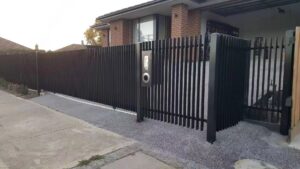
Privacy is one of the most consistent drivers behind fencing decisions in Melbourne — and increasingly, property owners are not willing to sacrifice aesthetics to get it. The era of the solid grey paling fence as the default privacy solution is giving way to something more considered: slat fencing and privacy screens that deliver genuine seclusion without looking like a construction barrier.
Aluminium slat fencing — also referred to as blade fencing — has become one of the fastest-growing fencing categories across Melbourne’s residential, commercial, and mixed-use sectors. The combination of clean horizontal or vertical lines, strong privacy performance, low maintenance, and design versatility has made it the go-to solution for properties where appearance and function need to work equally hard.
This guide covers what slat fencing and privacy screens actually are, how they are built, what the main design decisions involve, where they are used, and how to choose the right system for your property.
What is slat fencing?
Slat fencing — interchangeably called blade fencing in the Australian market — is a panel-based fencing system made up of individual blade-profile sections arranged in close, parallel rows, either horizontally or vertically, and fixed to a structural rail and post framework.
Unlike a solid wall or panel fence, slat fencing does not form a completely opaque barrier. Instead, the blades are positioned close enough together that sightlines through the fence are eliminated or heavily reduced from straight-on viewing angles, while still allowing some airflow and light to pass through the fence plane. The privacy effect comes from the geometry of the blade spacing relative to the viewing angle — from directly in front, you see the face of the blade. From an oblique angle, the view is blocked by the depth and overlap of adjacent blades.
This is an important distinction from solid fencing: slat fencing achieves privacy through clever engineering of the sightline, not through complete physical blockage. For most residential and commercial applications, this level of privacy is entirely adequate and comes with the added benefit of airflow, which solid fencing does not provide.
At Boswen, our slat fencing and privacy screen systems are manufactured from premium aluminium — powder-coated for durability and available in a range of blade profiles and configurations. View our full blade fence range for panel specifications and available heights.
Materials: why aluminium is the dominant choice
Slat fencing is available in several materials — timber, steel, and aluminium — and the material choice fundamentally affects durability, maintenance requirements, and long-term cost of ownership.
Timber slat fencing delivers a natural, warm aesthetic that suits certain architectural styles. However, in Melbourne’s climate — with its wide temperature swings, UV exposure, and periodic heavy rainfall — timber requires regular maintenance: sealing or oiling every one to two years, repainting if painted, and eventual replacement of warped or split boards. On a long fence run, this maintenance overhead accumulates into a significant ongoing cost. Timber also has less dimensional consistency than engineered aluminium, which can affect the uniformity of blade spacing over time.
Steel slat fencing offers strength advantages over aluminium and suits applications where structural rigidity or security grade is a priority. However, steel requires appropriate corrosion protection — hot-dip galvanising or quality powder-coat — and is heavier, which adds load to the post and footing system.
Aluminium slat fencing is the dominant choice for residential and light commercial applications in Melbourne for three reasons: it does not corrode (no galvanic oxidation in Melbourne’s climate, including coastal bayside areas), it is dimensionally stable (no warping, swelling, or shrinkage across temperature ranges), and it requires essentially no maintenance beyond an occasional wash-down. The powder-coat finish is applied electrostatically and baked on, providing a hard, UV-resistant surface that retains colour significantly longer than painted timber or powder-coated steel in comparable conditions.
For most Melbourne residential boundaries, commercial facades, and privacy screening applications, aluminium blade fencing is the correct material specification.
Blade profiles: understanding your options
The blade profile — the cross-sectional shape and dimension of each individual slat — determines the visual character, privacy performance, and structural depth of the fence. Boswen’s blade fence range includes two main profiles suited to different applications.
65 × 16mm blade
A wider, bolder blade profile with a more pronounced visual presence. The 65mm face width creates a stronger horizontal or vertical rhythm across the fence line, giving the installation a more substantial, architectural appearance. This profile is well suited to:
- Commercial frontages and building facades where visual impact is a design priority
- Residential front boundary fencing where the fence is a primary design element
- Applications where a more premium, high-end appearance is required
At 1.5m panel height with 80 gaps, this profile delivers strong privacy performance from standard viewing distances.
50 × 10mm blade
A slimmer, more refined blade profile with a lighter visual quality. The narrower face creates a denser, more subtle rhythm across the fence plane — appropriate where the fence should complement the surrounding architecture rather than dominate it. This profile suits:
- Side and rear boundary fencing where a refined, low-profile appearance is preferred
- Residential gardens and courtyard screening where integration with planting and landscaping is a priority
- Applications where the fence is read as background rather than feature
At 1.5m panel height with 50 gaps, this profile delivers excellent close-range privacy with a slightly more open character than the 65mm profile.
Both profiles are mounted on SHS40 (40mm square hollow section) rails, which provide the structural spine of the panel and are concealed within the blade assembly for a clean, frameless appearance from the front.
Horizontal vs vertical blade orientation
Beyond the blade profile, orientation — whether blades run horizontally or vertically — is a significant design and performance decision.
Horizontal blades are the more common choice in Australian residential fencing. The horizontal line reinforces a sense of width and ground connection, which works well on most residential block sizes and suits the low-pitched rooflines common in Melbourne’s inner and middle suburbs. Horizontal blades also provide better privacy at standard standing heights because the sightline gap between blades is perpendicular to the most common viewing angle.
Vertical blades create a more upright, formal character that suits certain architectural styles — particularly contemporary two-storey homes, commercial facades, and applications where the fence needs to read as a vertical plane in the landscape. Vertical blade fencing is also easier to install on sloped ground because the blades can be cut to follow the grade without disrupting the visual rhythm of the panel.
The choice between horizontal and vertical is primarily an architectural decision, but should be made with reference to your specific property context, the architecture of surrounding structures, and any council or body corporate guidelines that may specify a preference.
Where slat fencing and privacy screens are used in Melbourne
The versatility of aluminium blade fencing means it appears across a wide range of property types and applications across Melbourne.
Residential boundary fencing
The most common application — side and rear boundaries of Melbourne residential properties where privacy from neighbouring homes is the primary goal. Aluminium blade fencing installed at 1.8m delivers effective privacy from adjacent ground-floor windows and courtyards. For two-storey overlooking, taller panels or angled blade configurations may be considered, though these are site-specific design questions.
Front boundary and street-facing fencing
Front boundary fencing defines the street-facing edge of a property and contributes significantly to its kerb appeal. Aluminium blade fencing at 1.2m to 1.5m is increasingly common on Melbourne residential street frontages — particularly in the inner and middle ring suburbs where contemporary renovation and new construction are reshaping the streetscape. The clean, modern profile complements weatherboard, rendered brick, and Corten-clad contemporary architecture alike.
Alfresco and entertaining area screening
Outdoor dining and entertaining areas adjacent to neighbouring properties benefit from targeted privacy screening — a run of blade panels along the relevant boundary or fence line, typically 1.8m, that creates a sense of enclosure without completely walling in the space. This application is common in Melbourne’s inner suburbs where rear garden depths are modest and neighbouring windows overlook the outdoor living zone.
Commercial and retail facades
Aluminium blade fencing and screening panels are extensively used in Melbourne’s commercial sector — as building facade elements, car park screening, plant and equipment enclosures, and perimeter boundary fencing for commercial properties. The material’s dimensional stability and low maintenance make it particularly suitable for commercial applications where ongoing maintenance budgets are constrained and appearance standards are expected to be maintained over a long service life.
Townhouse and apartment developments
Body corporate-managed townhouse complexes and apartment developments use aluminium blade fencing for courtyard privacy screens, boundary fencing between lots, rooftop terrace screening, and balcony privacy panels. The consistent powder-coat finish across all panels maintains visual uniformity throughout the development.
Industrial and commercial screening
Plant rooms, utility enclosures, mechanical equipment, and loading dock screening in commercial and industrial settings are commonly clad with aluminium blade panels — creating a visually consistent screen that conceals operational infrastructure without the airflow restriction of a solid panel. This application prioritises the screening function over the privacy function, but the same product range serves both.
Slat fencing vs other privacy fence options
Understanding where slat fencing sits relative to other options helps you make a confident choice for your specific situation.
Slat fencing vs good neighbour fencing. Good neighbour fencing is the correct choice when the symmetrical appearance of the fence — identical from both sides — is the primary requirement, particularly on shared boundaries where both neighbours have an equal stake in the aesthetic. Slat fencing typically presents differently on each side (blade faces on one side, rail structure on the other) and is better suited to applications where one property owns the fence and design is the driver.
Slat fencing vs palisade fencing. Palisade fencing is specified where security and anti-climb performance are the primary requirements. Slat fencing prioritises privacy and design. These serve different needs and different settings — palisade on industrial and high-security commercial sites, slat fencing on residential and design-driven commercial applications.
Slat fencing vs colorbond-style panel fencing. Standard colorbond panel fencing is a solid, ribbed steel panel — opaque, heavier, and without the design character of blade fencing. It is cost-effective for large perimeter runs but lacks the architectural quality that blade fencing delivers. For design-conscious residential applications and commercial facades, blade fencing is the preferred specification.
Slat fencing vs timber privacy screens. Timber offers warmth and a natural aesthetic that aluminium cannot fully replicate. For applications where timber character is a design priority and maintenance is manageable, timber slat fencing or screening is a legitimate choice. For applications where maintenance-free longevity is required, aluminium is the correct material.
Key decisions before specifying slat fencing
Several decisions need to be made before a slat fence is properly specified. Getting these right at the start prevents costly changes during or after installation.
Height. In most Melbourne residential zones, fences up to 2.0m do not require a planning permit, but a building permit may apply for some fence types and heights depending on your council area. Fences over 2.0m on residential land generally require council assessment. Confirm your council’s specific requirements before deciding on height.
Blade profile and orientation. Discussed in detail above — these choices should be made with reference to your architectural context, not just personal preference in isolation.
Colour. Boswen’s blade fencing is powder-coated in black as the standard finish, with custom colour options available on request. In Melbourne’s residential context, Charcoal, Monument, and Woodland Grey are among the most popular alternative specifications — all coordinates well with the rendered, brick, and cladding materials common in Melbourne’s housing stock.
Post and footing design. Posts in Melbourne’s reactive clay soils — particularly prevalent in the northern, western, and outer south-eastern suburbs — need to be sized and set appropriately to prevent lean over time. An experienced installer will assess the soil profile at your site before specifying footing depth and diameter.
Gate integration. If the fence run includes a gate, the gate should be designed and fabricated to match the blade profile, height, and colour of the fence panels. A swing gate is the most common pedestrian access option alongside residential blade fencing; a sliding gate suits driveways and wider openings. Mismatched gates are among the most common finished-appearance issues on residential fencing projects — specifying both fence and gate from the same supplier eliminates this risk.
Is slat fencing the right choice for your property?
Slat fencing is well suited when:
- Privacy from neighbours is the primary driver and you want a modern, design-forward result
- You are replacing a deteriorating timber fence and want to upgrade to a low-maintenance aluminium system
- The fence is a visible architectural element — street-facing or alfresco-area-facing — where appearance carries design weight
- You need a fencing solution that coordinates with contemporary architecture or a recent renovation
- The boundary is yours alone and you are not constrained by a shared-fence symmetry requirement
It may not be the best choice when:
- Perimeter security is the primary need — palisade fencing or high security fencing provides better intrusion resistance
- A shared boundary requires equal presentation on both sides — good neighbour fencing is the right solution
- Budget is the primary constraint on a long perimeter run — chainwire or colorbond panel fencing delivers boundary delineation at lower upfront cost
- The site has extreme anti-climb requirements — palisade is better suited to that specification
Talk to Boswen about slat fencing in Melbourne
Boswen manufactures and installs aluminium blade fencing and privacy screens across Melbourne for residential, commercial, and industrial properties. Our team advises on blade profile, height, colour, and gate integration — and manages the full installation from site assessment to final panel.
View Boswen’s slat fencing and privacy screen systems →
View our blade fence panel specifications →
Frequently asked questions
How much privacy does slat fencing actually provide? At standard viewing distances from ground level, aluminium blade fencing at 1.5m to 1.8m height provides effective privacy from straight-on and near-oblique sightlines. It does not provide complete privacy from elevated positions (a neighbour’s second-storey window, for instance) — for those situations, a taller fence, angled blade configuration, or a combination of fencing and planting is more effective.
Does aluminium slat fencing rust? No. Aluminium does not rust — it forms a stable oxide layer that protects the base material. The powder-coat finish adds an additional layer of UV and weather protection. Aluminium blade fencing in Melbourne’s coastal and inland environments performs without corrosion-related degradation across its full service life.
How long does aluminium blade fencing last? A correctly installed aluminium blade fence with a quality powder-coat finish typically lasts 25 to 40 years in Melbourne’s climate with no repainting and minimal maintenance. The powder-coat should be inspected periodically for chips or scratches that expose the base aluminium — touch-up of these spots extends the finish life significantly.
Can slat fencing be installed on a slope? Yes, through either a raked installation (fence follows the slope continuously) or a stepped installation (fence drops in level sections). The blade orientation affects which approach looks better — vertical blades are generally more adaptable to raked installations, while horizontal blades suit stepped approaches on steeper slopes.
Do I need council approval for slat fencing? In most Melbourne residential zones, boundary fences up to 2.0m do not require a planning permit, though a building permit may apply. Rules vary by council. Boswen assesses permit requirements as part of every project scope.
Can the blade colour be customised? Yes. Standard finish is powder-coated black. Custom colour options are available to match specific architectural palettes or body corporate specifications. Lead times for custom colours vary — confirm at the quote stage.
Related reading
- Good neighbour fencing explained: what it is and why it matters — When a shared boundary requires equal presentation on both sides rather than a design-forward slat fence.
- How to choose the right fencing material for your commercial property — A broader material selection guide for commercial and mixed-use properties.
- The real cost of poor fencing installation and how to avoid it — Why installation quality matters as much as material selection for slat fencing longevity.
- Choosing the right fencing contractors for your property in Melbourne — What to look for when selecting a contractor for your slat fence installation.
Boswen Aust Pty Ltd is a Melbourne-based fencing and metalworks contractor. We design, manufacture, and install aluminium slat fencing, blade fence panels, privacy screens, steel security fencing, and gates across metropolitan Melbourne and regional Victoria. Our factory is located at 48 Prosperity Way, Dandenong South VIC 3175.