When it comes to securing a Melbourne industrial site, two fencing systems consistently come up in the same conversation: palisade and chainwire. Both are steel-based, both are widely used across Victoria’s commercial and industrial precincts, and both are proven performers in demanding environments.
So which one is right for your site?
The honest answer is that neither is universally better. The right choice depends on a specific set of variables — your site’s threat profile, the assets you are protecting, your budget parameters, and the long-term cost picture. This article works through each of those factors so that you can make a well-informed decision rather than a default one.
Understanding what each system is designed to do
Before comparing them, it helps to be clear on what each fence type is actually engineered for — because they were not designed for the same purpose.
Chainwire fencing — sometimes called cyclone wire or chain-link fencing — is a woven galvanised steel mesh stretched between posts and fixed to a top and bottom rail. Its core design priority is perimeter delineation at scale: enclosing large areas quickly, economically, and durably. It is flexible, adaptable to most ground profiles, and extremely cost-effective to install over long runs. Melbourne’s logistics precincts, construction sites, and sporting facilities use chainwire extensively for exactly these reasons. You can read more about how Boswen approaches chainwire fencing installations on commercial and industrial sites.
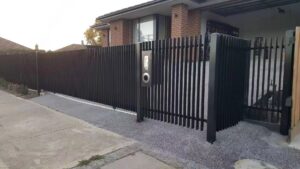
Palisade fencing is an engineered rigid barrier system — vertical steel pales, fixed to horizontal rails and structural posts, with pointed or serrated tops projecting above the fence line. Its design priority is active intrusion deterrence: making a fence that is physically difficult to breach, climb, or compromise. The structure is heavier, more imposing, and considerably harder to defeat than mesh-based alternatives. Boswen’s palisade fence systems are available in a range of pale profiles and heights to suit different security grades.
These different design intentions explain why the two systems suit different site profiles. Choosing between them is really a question of matching the fence to the threat — not picking a winner.
Comparing the two systems across the factors that matter most
1. Security performance
This is the most significant difference between the two systems, and it is worth being direct about it.
Chainwire fencing provides a meaningful physical barrier and clear boundary demarcation. It resists casual intrusion and makes boundary-crossing obvious. However, its mesh structure provides footholds throughout, which means a determined intruder with time and basic tools can scale or cut through a standard chainwire fence. For sites where the consequence of a breach is relatively low — construction site boundary fencing, for instance — this is an acceptable trade-off for the cost savings chainwire offers.
Palisade fencing is a substantially higher-security barrier. The rigid steel pales, projected pointed tops, and absence of footholds make climbing extremely difficult. Cutting or forcing individual pales requires specialist tools and significant time — time that works against the intruder and in favour of detection. For sites where a breach carries high consequences — theft of high-value goods, access to dangerous machinery, liability exposure, or damage to critical infrastructure — palisade’s higher security rating justifies its higher cost.
Verdict: Palisade wins on security performance. Chainwire is adequate for moderate-risk boundaries; palisade is the appropriate choice when the threat level or consequence of intrusion is elevated.
2. Cost — upfront and over time
Chainwire fencing has a lower upfront cost per linear metre than palisade. For large-run boundary fencing — enclosing a multi-hectare industrial estate, for example — this difference is meaningful and often the deciding factor for sites operating within a constrained capital budget.
However, total cost of ownership tells a more nuanced story. Both systems, when hot-dip galvanised to Australian standards, have long service lives. The difference emerges in damage and replacement cycles. Chainwire mesh, once cut or damaged, requires panel or section replacement and is vulnerable to localised failures that can go undetected. Palisade panels are more resistant to accidental or deliberate damage and, when a pale is damaged, it is typically replaceable in isolation without disturbing the surrounding structure.
For sites with high traffic, vehicle movement near the fence line, or a history of fence damage, palisade’s durability can reduce the 10-year maintenance cost considerably — even if the day-one installation price is higher.
Verdict: Chainwire is more cost-effective for large-run, lower-risk boundaries. Palisade has a higher upfront cost but a stronger long-term cost-of-ownership argument for high-risk or high-traffic sites.
3. Deterrence — what the fence signals before anyone touches it
Physical security research consistently shows that perimeter barriers influence criminal decision-making at the approach stage — before any attempt is made. The visual character of a fence matters.
Chainwire is read as a boundary marker. It signals that a line exists. In most settings it does not communicate active resistance to intrusion — experienced intruders know it can be defeated with the right tools.
Palisade is read differently. Its height, rigid steel uprights, and projected pointed tops communicate that the site has made a deliberate investment in making intrusion difficult. This visual deterrence effect — sometimes called the psychological barrier — is a genuine security benefit that does not appear in a material specification but does affect real-world intrusion rates.
For industrial sites in Melbourne’s outer western and south-eastern corridors where opportunistic theft is a persistent issue, this deterrence function has tangible value.
Verdict: Palisade delivers stronger visual deterrence. For sites where deterring the attempt matters as much as resisting it, this is a meaningful advantage.
4. Installation and site adaptability
Chainwire fencing is faster to install over long, flat, or moderately sloped runs. It adapts readily to undulating terrain by adjusting the mesh tension, and it can be installed in a continuous run without the panel-by-panel assembly that palisade requires. For a 500-metre boundary run on a relatively flat site, chainwire can typically be completed in significantly less time than an equivalent palisade installation.
Palisade requires more precise installation: posts must be set accurately to accommodate rigid panels, and the system is less tolerant of ground variation without additional design adjustment. On steeply undulating terrain, a stepped or raked installation approach is used, which adds time and cost.
That said, Boswen’s installation team regularly handles palisade fencing on challenging Melbourne sites — including reactive clay soil in the northern suburbs and variable grades in industrial estates — and proper site assessment at the quote stage eliminates most installation surprises.
Verdict: Chainwire installs faster and more flexibly over difficult terrain. Palisade requires more precise installation but can be adapted to most site conditions with proper planning.
5. Visibility and surveillance integration
Both systems are open-structure fences, meaning security cameras positioned inside the boundary can monitor approaches through the fence. This is an advantage both share over solid panel fencing.
The difference is that chainwire’s mesh structure can partially obscure camera views at certain angles and distances, particularly with smaller mesh apertures. Palisade’s open vertical structure typically provides cleaner sightlines through the fence line, which is a consideration for sites with extensive CCTV coverage.
For sites where surveillance integration is central to the security design, palisade’s sightline advantage is worth factoring in alongside the other differences.
6. Aesthetics and site profile
This matters more than it might seem, particularly for industrial sites with a public-facing boundary — along a main road, adjacent to a retail precinct, or near residential areas.
Chainwire has a functional, industrial appearance that reads as utilitarian. It is the right choice when the site’s primary concern is boundary delineation and cost, and when the visual environment does not require anything beyond a standard commercial fence.
Palisade has a more structured, formal appearance. In the right context — a facility that receives clients or visitors, or a site that wants to communicate professionalism alongside security — palisade presents better. It can also be powder-coated in a range of colours to suit site branding or council requirements.
A practical decision framework for Melbourne industrial site managers
Rather than a one-size recommendation, the following framework reflects how experienced fencing contractors actually approach this decision.
Choose chainwire when:
- Your boundary run is long (200 metres or more) and the primary need is delineation
- The site’s risk profile is moderate — construction, sporting facilities, standard warehousing
- Budget is the primary constraint and security risk is manageable
- The terrain is variable and installation speed matters
- You need a system that works alongside a high security fencing upgrade in higher-risk zones, with chainwire handling the lower-risk perimeter
Choose palisade when:
- The site contains high-value assets, dangerous equipment, or restricted areas
- After-hours intrusion risk is elevated — the site is isolated, poorly lit, or has experienced previous incidents
- You need a fence that communicates active security investment, not just boundary marking
- The site is subject to compliance requirements or insurance conditions specifying a security-grade barrier
- You want a low-maintenance perimeter solution over a 20-to-30-year horizon
- The fence will be visible from a main road or public space and appearance matters
Consider both in combination when: Some Melbourne industrial sites use both systems deliberately — chainwire along low-risk back boundaries and palisade along road frontages or at access-controlled entry zones. This approach optimises the security investment: maximum deterrence where it counts, cost efficiency where the risk profile allows. Pairing either system with security bollards at vehicle approach points adds an additional layer of protection against ram-raid or vehicle intrusion.
What about the entry points?
The gate system is as important as the fence itself — a high-grade perimeter loses its value if the entry point is the weak link. Chainwire and palisade fencing both pair effectively with the full range of gate types. Sliding gates and cantilever gates are the most common vehicle entry solutions on Melbourne industrial sites, offering smooth operation across high-traffic driveways. For pedestrian-only entry points, a pedestrian access gate integrated into either fence system provides controlled access without a secondary weak point in the perimeter.
The gate material and security grade should match the fence. Installing a lightweight gate into a palisade fence line undermines the investment in the fence itself.
Getting the specification right for your site
The decision between palisade and chainwire is not one to make from a product page alone. It requires a clear-eyed look at your site’s actual threat profile, your compliance obligations, your maintenance budget, and the 10-year picture — not just the day-one installation cost.
At Boswen, our team works through this assessment with every client before recommending a system. We have installed both chainwire and palisade across Melbourne’s industrial, logistics, infrastructure, and commercial sectors, and we can provide honest guidance on which system — or which combination — makes the most sense for your specific site.
View Boswen’s palisade fencing systems →
View Boswen’s chainwire fencing options →
Request a free site assessment and quote →
Related reading
- What is palisade fencing and where is it used in Melbourne? — A deeper look at palisade construction, applications, and what to expect from a professional installation.
- Why chainwire fencing remains the backbone of industrial site security — The case for chainwire in large-run, moderate-risk industrial applications.
- Chainwire vs weldmesh: which one’s right for your Melbourne facility? — If you have already decided on a mesh-based system, this article helps you choose the right mesh type.