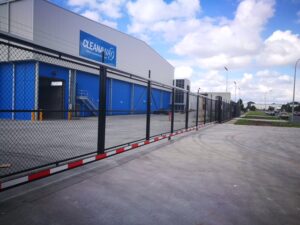
Choosing a driveway gate is not only a design decision. The gate must physically fit the site, clear the driveway, suit the slope, handle the expected traffic and provide the level of security and automation the property needs.
For Melbourne homes, commercial properties and industrial sites, three of the most common configurations are sliding, swing and cantilever driveway gates. Each can be secure and automated, but they use space differently and respond differently to ground conditions, wind, traffic and maintenance.
Boswen designs, fabricates and installs driveway gates across Melbourne and Victoria, including manual and automatic sliding, swing and cantilever systems. The right choice starts with the site rather than with a preferred gate style.
This guide compares the three configurations and provides a simple selection flowchart to help property owners and project teams narrow down the most practical option before a detailed site assessment.
Start with the Site Measurements
Before comparing gate styles, measure the entrance and the space around it. A gate can look suitable on paper but become impractical once the opening arc, run-back distance or driveway slope is considered.
Key measurements include the clear vehicle opening, the available space beside the driveway, the space inside the property, driveway gradient, crossfall, kerbs, drainage, nearby walls or landscaping, and the location of services.
Also consider how vehicles approach the gate. A long truck, delivery van or turning vehicle may need more waiting and manoeuvring space than a private car. The gate should not force vehicles to stop in an unsafe position while it opens.
These measurements immediately help eliminate unsuitable options. A site with no lateral run-back may not suit a conventional sliding gate. A steep driveway can make a standard swing gate difficult. A wide industrial opening with uneven ground may point toward a cantilever solution.
Sliding Driveway Gates
A sliding driveway gate moves horizontally beside the fence line. Boswen uses sliding gates for residential, commercial and industrial entrances where swing space is restricted or regular vehicle access makes lateral movement practical.
The main requirement is run-back space. The gate leaf needs enough clear length beside the opening to move fully out of the driveway. Fences, buildings, landscaping, changes in level and other obstructions must be checked before the design is finalised.
Tracked sliding gates also rely on a suitable ground path. The track area needs to remain aligned and reasonably clear so the gate can move consistently. Drainage, debris and heavy vehicle activity can therefore influence maintenance.
Sliding gates are commonly suited to automation because their movement is controlled along a defined path. For higher-use entrances, the gate structure, rollers, guides, track and operator should all be selected around the expected duty rather than treated as separate components.
When a Sliding Gate Usually Makes Sense
• There is enough clear run-back space beside the driveway.
• Swinging leaves would interfere with parking, circulation or buildings.
• The entrance has regular vehicle movements.
• The site can support a suitable track and drainage arrangement.
• A strong, automation-friendly gate configuration is required.
Swing Driveway Gates
Swing gates operate on hinges like large doors. They may use one leaf or two leaves that meet in the centre. For homes and light-commercial properties, they can provide a traditional entrance appearance without needing a long run-back zone beside the fence.
The critical constraint is the opening arc. The driveway must provide enough clear space for the leaf or leaves to swing without striking parked vehicles, walls, landscaping or people.
Slope is particularly important. If the driveway rises sharply in the direction of the swing, the bottom of the gate can meet the ground before the leaf opens fully. Special geometry can sometimes address this, but it should be resolved during design rather than after fabrication.
Wide or heavy swing leaves also place significant load on hinges and gate posts. Wind can add further force, especially with solid or privacy-style infill. Structural design and automation selection should therefore reflect leaf size, material and exposure.
When a Swing Gate Usually Makes Sense
• There is clear space for the gate leaves to open.
• The driveway gradient does not interfere with the opening arc.
• The property owner prefers a traditional or symmetrical entrance.
• There is limited side space for a sliding gate.
• Traffic levels and gate dimensions suit the proposed hinge and automation system.
Cantilever Driveway Gates
A cantilever gate slides sideways but is supported so that it does not need a ground track across the driveway opening. Boswen uses cantilever systems where challenging ground conditions, frequent traffic or the need to keep the driveway surface clear make a tracked gate less desirable.
The absence of a track through the vehicle path can be useful on uneven ground, gravel, industrial entrances or areas where debris may collect. It also removes one component from the part of the driveway crossed by vehicles.
Cantilever gates still require side space. In fact, the supporting tail section means the overall gate assembly is longer than the clear opening. The design therefore needs adequate run-back beyond the opening as well as properly engineered support posts, rollers and foundations.
For commercial and industrial entrances, cantilever gates can be paired with electric automation and access control. The larger structure and support system can, however, make initial fabrication and civil works more involved than a simpler swing or tracked sliding gate.
When a Cantilever Gate Usually Makes Sense
• A ground track across the driveway is undesirable.
• The entrance has uneven ground, gravel or frequent debris.
• Vehicle traffic is frequent or heavy.
• There is sufficient side space for the longer cantilever assembly.
• The project can accommodate the required support structure and foundations.
Space and Slope: The Fastest Way to Narrow the Choice
Space and slope are usually the quickest filters when selecting driveway gates in Melbourne.
If there is a large clear area inside the property and the driveway is relatively level, a swing gate may be straightforward. If there is little swing space but plenty of fence line beside the opening, a sliding configuration becomes more attractive. If a sliding movement is preferred but a track across the driveway would be problematic, a cantilever gate is worth assessing.
A steep slope can affect all three options differently. Swing leaves can strike rising ground. A tracked sliding gate needs a workable path along the travel line. A cantilever gate avoids the driveway track but still requires a properly designed support zone and adequate side clearance.
Do not rely on the driveway opening width alone. The space where the gate moves when open is just as important as the opening itself.
Traffic Volume and Duty Cycle
A gate serving a private driveway has a different operating profile from one serving a warehouse, school or logistics facility.
For a low-frequency residential entrance, appearance and convenient operation may be the main priorities. For a commercial site, the gate may open repeatedly during morning arrivals, deliveries and staff movements. Industrial entrances can also require wider openings and more robust structures.
Frequent use increases the importance of alignment, gate hardware, automation duty and maintenance access. Sliding and cantilever gates are often considered for high-traffic vehicle entrances, but the correct configuration still depends on the physical site.
When asking for a quote, give the installer an approximate number and type of vehicle movements, including peak periods. This helps distinguish a light-use entrance from a gate that needs to operate reliably throughout the working day.
Automation and Access Control
Sliding, swing and cantilever driveway gates can all be automated when the gate and site are suitable. The motor should be selected after the gate type, size, weight, geometry and operating frequency are known.
Access control can include remote controls, keypads, cards or fobs, intercoms and vehicle sensors, depending on the project. The right system should reflect who uses the gate, how visitors are handled and what happens outside normal operating hours.
Safety devices are also part of the automatic gate system. Their selection depends on the gate movement, user environment and site risks.
For broader information about motor sizing, duty cycle, power, safety sensors and manual release, Boswen’s dedicated automatic-gates guidance should be used rather than turning this driveway-gate comparison into a detailed automation article.
Appearance and Street Presentation
Gate configuration affects more than movement. It also changes the way an entrance looks.
Double swing gates can create a symmetrical frontage and are often chosen where the entrance design is meant to feel traditional or formal. Sliding gates provide a clean single-plane movement and can work with contemporary steel, aluminium or slat-style infill. Cantilever gates can achieve a similar visual effect to sliding gates while keeping the driveway opening free of a ground track.
Material, infill, colour and adjacent fencing should be considered together. A gate should look like part of the perimeter rather than a separate component added later.
Wind exposure should be assessed whenever the design uses large solid or semi-solid panels. Open designs generally allow more airflow, while privacy-style infill can increase the forces acting on the leaf and automation.
Maintenance Differences
Every driveway gate requires inspection and maintenance, but the points to watch vary by configuration.
Tracked sliding gates rely on rollers, guides and a clear track zone. Swing gates depend heavily on hinges, posts, stops and leaf alignment. Cantilever gates use support rollers and a structural counterbalance arrangement that needs to stay aligned.
Automated systems add motors, controls, sensors and other components. A gate that becomes mechanically difficult to move should be repaired rather than asking the motor to compensate for misalignment or damaged hardware.
The best design is not always the gate with the fewest components. It is the configuration that is easiest to keep reliable in the actual site environment.
What Affects Driveway Gate Cost?
Driveway gate pricing depends on more than the label ‘sliding’, ‘swing’ or ‘cantilever’. Cost is affected by opening width, gate height, frame and infill material, finish, posts and foundations, ground works, automation, safety devices, access control and installation conditions.
A simple manual swing gate may require fewer specialised components than a large automated cantilever system. However, choosing a cheaper gate type that does not suit the site’s slope or clearance can create higher modification and maintenance costs later.
For a meaningful comparison, quotes should describe the complete system: gate structure, supports, track or cantilever hardware, automation, safety equipment, access control, civil works and commissioning.
Driveway Gate Comparison
| Factor | Sliding | Swing | Cantilever |
| Movement | Slides along fence line | Leaf/leaves rotate through an arc | Slides beside fence without track across opening |
| Key space need | Lateral run-back | Clear swing arc | Extended lateral run-back for gate and support tail |
| Slope sensitivity | Needs suitable travel path | Rising ground can obstruct leaves | Avoids driveway track but support area still needs design |
| Traffic | Well suited to regular vehicle use when specified correctly | Suitable where operating space and duty allow | Often considered for frequent/heavy vehicle environments |
| Maintenance focus | Track, rollers and guides | Hinges, posts and stops | Support rollers, alignment and structure |
| Automation | Common | Available | Common |
Simple Driveway Gate Selection Flowchart
Step 1: Is there enough clear space for the gate to swing without obstructing vehicles, people or buildings?
YES → A swing gate may be suitable. Check driveway slope and wind exposure.
NO → Continue to Step 2.
Step 2: Is there enough clear fence line beside the opening for a gate to slide fully open?
YES → A sliding or cantilever gate may be suitable.
NO → The entrance may require a custom configuration, telescopic solution or layout change.
Step 3: Is a ground track across the driveway acceptable and practical to maintain?
YES → Assess a tracked sliding gate.
NO → Assess a cantilever gate.
Step 4: Is the entrance high-use, exposed to heavy vehicles, uneven ground or frequent debris?
YES → Give extra weight to duty, structural design and whether a cantilever system is more practical.
NO → Compare appearance, budget, maintenance and automation preferences.
The flowchart is a screening tool, not a final specification. A site measure is still needed to confirm dimensions, foundations, drainage, structural requirements and automation.
Choosing the Right Driveway Gate in Melbourne
There is no universal winner between sliding, swing and cantilever driveway gates. The right configuration is the one that fits the property’s movement space, slope, traffic and security requirements with the fewest compromises.
A swing gate is often attractive where the driveway is level and there is room for the leaves to open. A sliding gate suits sites with useful side clearance and restricted swing space. A cantilever gate can solve problems where a ground track is undesirable and the site has enough room for the longer supported structure.
Boswen designs and installs driveway gate systems for residential, commercial and industrial properties across Melbourne and Victoria. A site assessment can compare the practical options before the gate, foundations, automation and access control are specified.
| Not sure which driveway gate suits your property? Boswen can assess the opening, slope, run-back space, traffic and automation requirements and recommend a sliding, swing, cantilever or alternative configuration. Request a driveway gate quote |
Frequently Asked Questions
Which driveway gate is best for a sloping driveway?
It depends on the direction and severity of the slope. Rising ground can interfere with swing gates, while sliding gates need a suitable travel path. A cantilever gate avoids a ground track across the driveway but still requires adequate lateral space and engineered support.
Do sliding gates need more space than swing gates?
They need a different type of space. Sliding gates require clear run-back beside the opening, while swing gates require clear space through the opening arc. The site layout determines which is easier to accommodate.
Are cantilever gates suitable for residential driveways?
They can be, particularly where a ground track is undesirable, but they require a longer overall gate assembly and suitable foundations. They are also widely used for commercial and industrial entrances.
Can sliding, swing and cantilever gates all be electric?
Yes, each configuration can be automated when the gate structure and site are suitable. Operator selection should reflect gate size, weight, geometry, frequency of use and safety requirements.
How do I compare driveway gate quotes?
Compare the complete scope rather than only the gate price. Check the gate frame and infill, posts and foundations, track or cantilever hardware, automation, safety devices, access control, civil works, commissioning and maintenance support.“