Logistics and warehouse facilities need perimeter security that protects stock and operational areas without making it difficult to monitor what is happening along the boundary. Vehicle movements, staff access, deliveries and day-to-day site activity all place practical demands on the fence line and its gates.
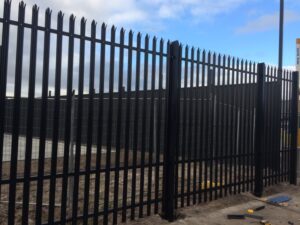
For this completed logistics-facility project, Boswen was engaged to replace a deteriorating perimeter that no longer met the site’s security needs. The documented scope included heavy-duty chainwire fencing around the facility perimeter, reinforced posts, tension wires and secure gates for both vehicle and pedestrian access.
The project demonstrates why chainwire fencing remains a practical option for commercial and industrial sites: it can create a clearly defined, durable perimeter while retaining visibility through the fence line. Just as importantly, the fence, posts and access points can be designed as one system rather than as separate components.
Verified project summary
| Item | Verified project detail |
| Facility type | Logistics / warehousing facility |
| Initial condition | Existing perimeter fencing was deteriorating and required an upgraded security solution |
| Fence scope | Heavy-duty chainwire fencing installed around the facility perimeter |
| Structural elements | Reinforced posts and tension wires |
| Access | Secure gates for vehicle and pedestrian access |
| Reported outcome | Improved site safety and reduced unauthorised-entry incidents, according to Boswen’s archived case-study record |
The Facility and the Security Challenge
The client operated a logistics and warehousing facility where the perimeter had a direct role in protecting valuable inventory and controlling access to operational areas. Boswen’s archived project record notes that the existing fence was deteriorating and was no longer considered adequate for the site’s updated security requirements.
That creates a different design problem from fencing an empty site or low-traffic boundary. A logistics perimeter has to work around people and vehicles while remaining easy to inspect. Weak sections, loose mesh, damaged posts or poorly coordinated gates can undermine the whole boundary even if most of the fence still appears serviceable.
Boswen’s role was therefore to deliver a more robust perimeter system and secure access points without treating the gates as an afterthought.
Why Chainwire Fencing Suited the Perimeter

Chainwire fencing is widely used on industrial and logistics sites because it combines physical separation with open sightlines. Security teams and site personnel can see through the mesh, which helps keep the boundary visually connected to the rest of the facility rather than creating a solid visual barrier.
For this project, the verified scope confirms heavy-duty chainwire fencing around the facility perimeter. The archived record does not specify the exact mesh aperture, wire gauge, fence height or coating, so those details should not be added to the published case study unless they are confirmed from project documentation.
What can be stated confidently is that the fence was paired with reinforced posts and tension wires. That combination matters because chainwire performance depends on the supporting structure and correct tension, not on the mesh alone. A fence line that is properly supported is better able to maintain alignment and resist the everyday demands of a commercial site.
Fence Specification: Strength Without Unverified Detail
Good case studies should show technical competence without inventing specifications. In this project, the available Boswen record verifies heavy-duty chainwire, reinforced posts and tension wires, but it does not publish the exact post centres, footing sizes, rail configuration, mesh gauge, coating or overall fence height.
Those values can materially affect performance and cost, and they should always be chosen for the individual site. On a new logistics or warehouse project, Boswen would normally assess the required security level, ground conditions, perimeter length, vehicle exposure, access points and operating environment before finalising the chainwire fence installation specification.
This site-specific approach is more useful than presenting one standard chainwire specification as suitable for every industrial perimeter.
Vehicle and Pedestrian Gate Requirements
The archived scope confirms secure gates for both vehicle and pedestrian access. This is an important part of the project because the access points are often the most operationally demanding sections of a perimeter.
A chainwire fence gate needs to coordinate with the adjoining fence while also handling movement, locking and repeated use. Vehicle gates must suit the required clear opening and traffic pattern, while pedestrian gates should support controlled staff or visitor access without forcing people into vehicle routes.
The public project record does not identify the gate type, dimensions or whether automation was installed. Those details should remain unspecified unless Boswen’s project files confirm them. Where automatic access is required on future logistics projects, it can be planned separately around traffic frequency, gate geometry, safety devices and access-control requirements.
Site Preparation and Perimeter Coordination
Although the archived case study does not publish a detailed construction programme, replacing or upgrading perimeter fencing at an operational logistics property requires careful coordination. Fence lines have to be set out accurately, posts and gate locations must align with the site plan, and the work zone must remain separated from normal operations.
For new projects, practical planning should consider underground services, pavement and soil conditions, drainage, truck circulation, loading areas and any sections where temporary security is required while the permanent fence is being installed.
These factors influence the installation method even when the visible finished product is simply a straight chainwire boundary. The quality of the preparation determines whether posts stay aligned, mesh maintains tension and gates operate correctly.
Installation Around Logistics Operations
Logistics facilities often cannot stop operating simply because perimeter work is underway. For that reason, fencing installation should be sequenced so that construction activity, deliveries, vehicle routes and site security can coexist safely.
The project archive confirms the completed chainwire perimeter and secure gates, but it does not document the exact staging plan used on this site. Rather than inventing that programme, the lesson for similar projects is to agree access windows, work zones, temporary controls and gate handover requirements before installation begins.
For builders and facility managers, this coordination can be as important as the fence material itself because an otherwise well-designed system can still create disruption if installation clashes with normal site movements.
Safety and Operational Coordination
The fence upgrade had to support the facility’s security purpose while allowing legitimate vehicle and pedestrian access. That balance is central to commercial perimeter design.
Clear visibility through chainwire can be useful in operational environments because it avoids creating blind solid sections along the boundary. At the same time, access gates need to be positioned and controlled so that authorised movement does not weaken the perimeter.
For future logistics projects, the design team should review vehicle turning paths, pedestrian separation, gate opening zones, emergency access and any areas where forklifts or trucks operate close to the fence. These are project-specific matters and should be resolved during site measure and design rather than assumed from a standard detail.
Project Results
Boswen’s archived case-study record states that the completed installation provided the facility with a more durable and secure perimeter and that the client reported improved site safety and fewer unauthorised-entry incidents.
The significance of that outcome is not simply that a new fence was installed. The project replaced a deteriorating boundary with a coordinated system of heavy-duty chainwire, reinforced posts, tensioning and secure access gates.
For a logistics site, that creates a perimeter that is easier to understand, inspect and manage as part of day-to-day operations.
Lessons for Other Logistics and Warehouse Projects
Assess the whole perimeter, not only the damaged section.
A failing fence can involve mesh, posts, tension, gate alignment and site conditions. A complete condition review helps define whether targeted repairs or a broader replacement will provide better value.
Treat gates as part of the fence design.
Vehicle and pedestrian gates should be planned with the perimeter because their posts, openings, movement and locking requirements affect the surrounding fence.
Specify for the site rather than copying a generic detail.
Mesh, height, posts, coatings, bracing and gate configuration should reflect the security requirement and operating environment.
Preserve visibility where it supports operations.
Chainwire can provide a secure physical boundary without completely blocking views across the site, which can suit logistics, industrial and service-yard applications.
Plan installation around ongoing operations.
Staging, access routes and temporary controls should be agreed before work begins on an active facility.
Chainwire Fencing for Logistics and Warehouse Sites
This completed project shows how chainwire fencing can be used as a practical commercial perimeter when the system is designed around the actual site. The value came from the combination of heavy-duty mesh, reinforced support, correct tension and secure access points rather than from any one component in isolation.
Boswen designs and installs chainwire fencing for commercial and industrial properties, including logistics facilities, warehouses, schools, sporting sites and other large perimeters. Project specifications can be tailored to the required security level, site layout, ground conditions and access requirements.
| Planning chainwire fencing for a logistics or warehouse facility? Discuss the perimeter, vehicle access, pedestrian gates and site conditions with Boswen to develop a project-specific chainwire fencing solution. Request a free quote |