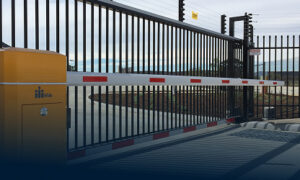
A chainwire fence is only as practical as the access points built into it. For warehouses, service yards, schools, sports facilities and secured compounds, the gate must do more than simply close an opening. It needs to match the fence, suit daily traffic, operate safely, fit the available space and provide the level of access control the site requires.
That is why choosing a chainwire fence gate should start with how the entrance will actually be used. A narrow pedestrian opening, a maintenance-vehicle entrance and a high-frequency truck access point may all sit within the same chainwire perimeter, but each can require a different gate configuration.
Boswen designs and installs chainwire fencing systems for commercial, industrial, education and sporting environments. The gate is considered as part of the complete perimeter rather than as an afterthought, including the frame, mesh infill, posts, hinges or track, ground clearance, locking method and any required automation or access control.
The main choices are pedestrian gates, single swing gates, double-leaf swing gates and sliding chainmesh gates. The right option depends on opening width, available operating space, traffic type, ground conditions, security expectations and how often the gate will be used.
Pedestrian Chainwire Gates
Pedestrian gates are the simplest access point within a chainwire or cyclone fence, but they still need to be designed around real site use. A school boundary may need controlled staff access, a sports facility may require separate spectator or maintenance entries, while an industrial site may need a staff gate positioned away from vehicle movements.
A good pedestrian gate should match the fence height and mesh style where appropriate, provide a rigid frame, maintain sensible ground clearance and use hardware suited to the expected level of use. Latches, locks, closers or access-control devices may be added depending on the site.
The position of the gate matters as much as its size. It should support natural pedestrian movement without creating conflicts with vehicles, loading areas or other hazards. For secured sites, designers should also consider whether the pedestrian entrance needs to be independently locked or monitored when the vehicle gate is open.
Single Swing Chainwire Gates
A single swing gate is often suitable for smaller vehicle openings, service access points and areas where one gate leaf can open freely without obstructing traffic or internal operations. The gate is hinged from one side and swings inward or outward depending on the site layout and safety requirements.
The main advantage is simplicity. There is no sliding track across the opening, and the hardware can be straightforward when the gate is correctly sized and supported. However, the site must have enough clear swing space for the full leaf. A large single leaf also places greater loads on the hinge post than a smaller pedestrian gate, so the frame, post and footing need to suit the gate dimensions and expected use.
Wind exposure should also be considered. Even though chainwire mesh is open, a large gate frame still presents a significant moving structure, especially when signage, privacy screening or other materials are attached later.
Double-Leaf Chainwire Gates
Double-leaf gates divide a wider opening into two hinged leaves. They are commonly considered where trucks, maintenance vehicles or occasional large equipment need access but a sliding gate is not required or there is insufficient run-back space for one.
Because each leaf is shorter than a single gate spanning the full opening, a double-leaf configuration can be easier to support and operate. One leaf may also be used independently for narrower access in some designs, while both leaves are opened when the full width is required.
The centre meeting point needs careful detailing. Drop bolts, locking hardware, stops and ground sockets should be positioned so the gate can be secured without creating avoidable trip or vehicle hazards. On sloping ground, the arc of each leaf must be checked before fabrication because the bottom rail can foul the surface as the gate opens.
For sites that open and close the entrance many times each day, the operating method deserves particular attention. A manually operated double-leaf gate may be suitable for occasional service access, but frequent traffic may justify a different configuration or automation strategy.
Sliding Chainmesh Gates
A sliding chainmesh gate moves horizontally rather than swinging into the site. This can be a strong option where the driveway needs to remain clear, swing space is restricted or the entrance carries regular vehicle traffic.
Sliding gates can run on a ground track or use a cantilever-style arrangement, depending on the gate design and site conditions. The choice affects the civil work, run-back space, maintenance requirements and automation system. A tracked gate relies on a clear, properly aligned track zone, while other sliding designs may avoid a track directly across the vehicle path.
The critical measurement is not only the clear opening. A sliding gate also needs adequate space beside the opening for the leaf to travel into when open. Fences, buildings, landscaping, services, changes in level and other obstructions all need to be checked during the site measure.
For busy commercial and industrial entrances, sliding gates are often compatible with automated operation and access-control systems. However, automation should follow the physical gate design, not drive it. The gate still needs to be structurally appropriate, correctly aligned and able to move freely before an operator is specified.
Gate Frames and Chainwire Mesh Infill
The gate frame provides the rigidity that the flexible chainwire mesh cannot provide by itself. The frame size, bracing and posts should therefore be selected for the leaf width, height, operating method and expected duty.
Mesh infill is normally selected to coordinate with the adjoining fence so the perimeter has a consistent appearance and security level. Depending on the project, this may include galvanised chainwire or PVC-coated chainmesh. The mesh should be fixed and tensioned so it remains secure within the gate frame without excessive sagging or loose edges.
For security fencing and gates, AS 1725.1 provides a framework with a range of alternatives for chain-link fabric, coatings, fence height, pipe grades and gate design. The exact specification should be selected for the site rather than assuming one standard gate detail will suit every project.
Hinges, Tracks and Gate Hardware
Hardware is a small part of the visible gate, but it has a major effect on long-term performance. Swing gates depend on hinges, posts and stops that can carry the leaf while maintaining alignment. Sliding gates depend on rollers, guides, tracks or cantilever hardware that keep the gate moving consistently along its travel path.
Commercial gates should be specified for the expected cycle rate and environment. A gate that opens a few times each week has a different duty from an entrance serving staff, deliveries and fleet vehicles throughout the day.
Locks, drop bolts, gate stops and latches should also be selected with the operating routine in mind. The aim is to avoid a gate that is technically secure but inconvenient enough that users routinely leave it unsecured.
Automation Without Losing Sight of the Gate Design
Chainwire gates can be automated where the site requires controlled or frequent vehicle access. Sliding gates are commonly suited to motorised operation, while some swing configurations can also be automated when there is sufficient geometry and appropriate hardware.
Automation introduces additional considerations such as operator capacity, safety devices, power supply, emergency access, opening speed, controls and maintenance. Access may be managed using devices such as remote controls, keypads, cards, fobs, intercoms or vehicle sensors, depending on the broader site requirements.
For this reason, the gate and automation system should be designed together. Retrofitting an operator to a gate that was never designed for automation can create avoidable compromises in movement, structural capacity or safety.
Access Control for Chainwire Fence Gates
Access control determines who can open the gate and when. For a school or staff compound, the requirement may be different from a logistics yard receiving vehicles throughout the day.
A pedestrian gate may need a keypad, card reader or intercom, while a vehicle gate may use remotes, fobs, sensors or integration with a wider access-control system. The important point is to define the operating process before finalising the gate. Who needs access? At what times? How are visitors handled? What happens during a power failure or emergency?
These questions influence not only the electronics but also gate location, opening direction, hardware and the relationship between pedestrian and vehicle access.
Ground Clearance, Slopes and Site Conditions
Ground conditions can quickly rule out an otherwise attractive gate option. Swing gates need enough clearance across their entire opening arc. A driveway that rises sharply behind the gate may cause the bottom rail to strike the ground before the leaf can open fully.
Sliding gates need a clear travel path and suitable levels along the run. Tracked systems also depend on the track zone remaining functional under site conditions. Drainage, debris, pavement condition and heavy-vehicle movements should be considered before installation.
Chainwire fencing can adapt well to changing ground levels, but the gate is a rigid moving element. That makes an accurate site measure especially important at every access point.
What to Measure Before Choosing a Chainwire Gate
Before a gate type is selected, a site measure should confirm:
• the required clear opening width and gate height
• whether access is pedestrian, light vehicle, truck or mixed use
• available swing space or sliding run-back space
• ground levels, crossfall and driveway slope
• position of fences, buildings, kerbs, services and drainage
• expected opening frequency and whether automation is required
• locking and access-control requirements
• vehicle turning paths and safe separation from pedestrians
• required mesh finish and coordination with the adjoining chainwire fence
• site security, maintenance and operational constraints
These measurements allow the gate to be designed around the site instead of forcing the site to accommodate a standard gate.
Chainwire Gate Options at a Glance
| Gate type | Typical use | Space requirement | Key strength | Main design check |
| Pedestrian gate | Staff, school, sports and controlled foot access | Small opening | Simple dedicated access | Width, latch, closer and access control |
| Single swing | Smaller vehicle or service access | Full swing arc | Simple gate arrangement | Leaf size, hinge post and slope |
| Double-leaf swing | Wider occasional vehicle access | Two swing arcs | Wide opening without slide run-back | Centre locking, drop bolts and ground clearance |
| Sliding chainmesh | Regular vehicle access and restricted swing space | Run-back beside opening | Keeps driveway clear | Travel path, track/cantilever system and alignment |
Choosing the Right Gate for the Perimeter
There is no single best chainwire fence gate for every property. A pedestrian gate may be the most important access point at a school, while a logistics site may depend on a wide sliding gate that can handle regular truck movements. A service yard may only require a manually operated double-leaf gate that opens occasionally.
The strongest specification is the one that aligns the gate with how the site operates. Opening width, traffic volume, ground conditions, security requirements, available space and future automation should all be considered before fabrication begins.
Boswen designs chainwire fencing and gate systems as integrated perimeter solutions. For commercial, industrial, education and sporting projects, the team can assess the site, confirm the most practical gate configuration and coordinate the gate with the surrounding chainwire fence.
| Planning a chainwire fence and gate system? Request a custom chainwire gate design from Boswen based on your opening width, traffic, site conditions and security requirements. Request a free quote |
Frequently Asked Questions
Can a chainwire fence gate be automated?
Yes. Depending on the gate type, structure and site conditions, chainwire vehicle gates can be designed for automated operation. Sliding gates are commonly compatible with gate operators, while swing gates can also be automated where the geometry and hardware are suitable.
Is a sliding chainwire gate better than a swing gate?
Not automatically. Sliding gates are useful where swing space is limited or traffic is frequent, while swing gates can be simpler for smaller or less frequently used openings. Site layout, opening width, ground conditions and operating frequency should guide the choice.
Can a chainwire gate match black or green PVC-coated fencing?
Yes. Chainmesh infill and surrounding fence finishes can be coordinated where the project specification calls for galvanised or PVC-coated chainwire. Gate frames and other components should also be selected to suit the required finish and environment.
What is the best gate for a wide chainwire fence opening?
A double-leaf swing gate or sliding gate may suit a wide opening, depending on the available swing area, run-back space, ground levels and traffic frequency. A site measure is the best way to determine the practical option.
Should the pedestrian gate be separate from the vehicle gate?
For many commercial, school and industrial sites, separating pedestrian and vehicle movements can improve access control and reduce conflicts. The exact arrangement should reflect the site layout, traffic and safety requirements.